Mapping Decadence: Interview

Hello everyone,

I know I have not posted in a while, but I have been really busy this summer working on my dissertation and my mapping project.

I was interviewed a few weeks ago about the latter and the article has finally been published online (and has made it to the Penn State News page as well). I hope you enjoy reading it and learning more about what I am trying to achieve with this map.

I can’t wait to start the next step of this project. It seems that I come up with new ideas every week. Now it is just a question of thinking about what is doable.

IAH Summer Residency

Great news: I have been selected as one of four recipients of the Institute for the Arts and Humanities Summer Residency (see my name at the very bottom of the page). What does it mean? I am receiving a grant of  4,000 dollars that will enable me to complete my dissertation and work on my “Mapping Decadence” article. It also means I won’t have to work in the summer, which will give me plenty of time to research and write.
I am very thankful for this opportunity.

The Graduate Exhibition

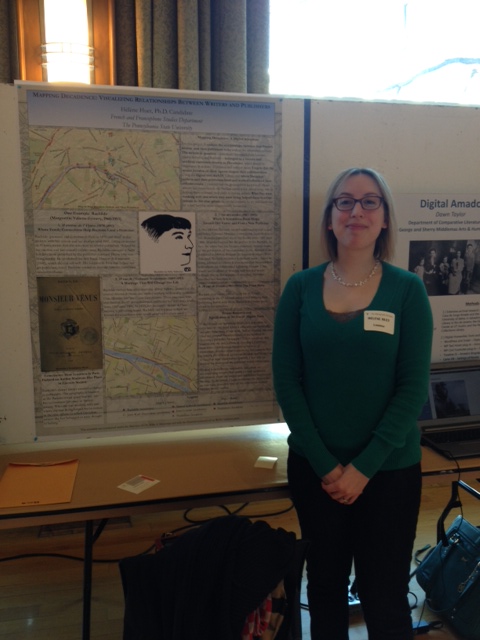
Yesterday, the Graduate School at Penn State hosted its Graduate Exhibition. It was the first time I participated. It is a great way for graduate students from very diverse fields to showcase their research and explain to people outside their field what they do. It is a tough exercise since we usually talk to people from our own field, but quite a worthwhile one.
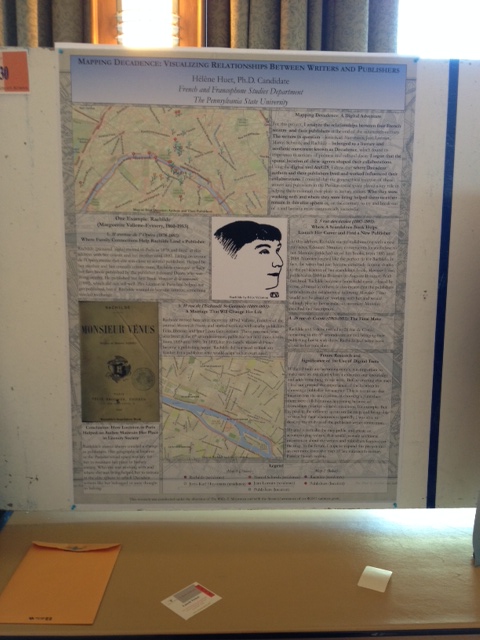
I presented on my mapping project and many people were really interested in what I do. I can’t wait to develop this project even further.
You can find my poster here if you wanted to have a closer look. I uploaded it in Penn State’s repository, ScholarSphere.
My poster and Myself My Poster

DH Awards: Time to Vote

Have you heard about the DH Awards? It started in 2012 and the goal is to recognize excellence in Digital Humanities.
The public nominates and votes for their favorite articles, tools or websites. The winners do not get any financial prize out of it, but it enables lots of projects to be in the spotlight. This year, there is even an award for the best contribution not in the English language. It’s too bad there is nothing in French. Hopefully, next year? (my “Mapping Decadence” project will most likely be in English, but maybe in the long term I will include a French translation).
The categories are as follows:
– Best DH contribution not in the English language
– Best use of DH for fun
– Best DH visualization or infographic
– Best DH tool or suite of tools
– Best DH blog post, article, or short publication
– Best DH project for public audiences
Here is the link for you to look at what’s being done in DH all over the world and to vote for your favorite projects.
Introduction to Scalar Workshop

This spring semester, Penn State’s Libraries’ Publishing and Curation Services will launch a series of workshops dedicated to publishing tools.
The first workshop will be an Introduction to Scalar, an easy-to-use, online publishing tool and will take place on February 13, from 11 am until noon.
You can find more information as well as the registration form here: https://digitallab.psu.edu/dhguide/event-registration/?ee=2
I am leading this workshop so clearly, you should attend!
Update: We have now officially launched our spring series of workshops. You can find more information here.

Interview With Katherine Rowe

Hello everyone,
I just wanted to let you know that the interview I did with Dawn Taylor (PhD candidate in comparative literature) of Prof. Katherine Rowe is now online. Katherine Rowe is an English professor at Bryn Mawr College and came to Penn State last October to talk about how she “uses digital humanities to explore the rhetoric of scholarly walking in the context of a small set of virtual Shakespearean locales”.
Enjoy.

Mapping Decadence: Conference

Good morning,
WSFH has finally uploaded the videos of the different panels that were recorded live and webcast during the conference.
If you want to hear more about my project, you can now watch me talk about it.
David Del Testa (Bucknell) was the commentator. You can find the video of his comments on the presentations here.
If you have any questions, please feel free to comment on this post.