I will be presenting on Mapping Decadence at SHARP 2015 this July in Montréal. This is very exciting because SHARP has a Digital Project Showcase, which is where I will be talking about my very own digital mapping project. Looking forward to it and to visiting Montréal. It will also be great to have some feedback from colleagues on where to take my project next.
Author Archives: admin
Great News
I’m very pleased to announce that my article “Mapping Decadence: From a Hunch to a Website” will be published in March by the Journal of Map & Geography Libraries. Looking forward to having more people hear about my project and the role libraries played in it.
2014 in review
The WordPress.com stats helper monkeys prepared a 2014 annual report for this blog. Thanks to everyone who visited it.

Here’s an excerpt:
A San Francisco cable car holds 60 people. This blog was viewed about 890 times in 2014. If it were a cable car, it would take about 15 trips to carry that many people.
OpenCon 2014
This coming weekend, I will be off to Washington DC to attend the OpenCon 2014 conference.
So what is OpenCon? The full title of the conference is Student and Early Career Researcher Conference on OpenAccess, Open Education, and Open Data. Attendees are coming from all over the world: from England and South Africa to Germany and Canada. I am very lucky to have been chosen by the Dean of the Penn State libraries, Barbara I. Dewey, to receive a fellowship to attend this conference.
Open Access
The first time I heard about Open Access was when I started my position as the Digital Scholarship Services Graduate Assistant in the Penn State Libraries, back in August 2013. For a junior scholar like me, Open Access is incredibly exciting as it offers a way for people to learn about my passion and my work. I love the idea of sharing my research and my data, because I believe that our role, as scholars, is to share our knowledge with as many people as possible. To support Open Access, I have made two documents available online — a conference paper and a poster — both of which I have uploaded on Penn State’s institutional repository ScholarSphere. Users from all over the world can download these documents and access my research. I am also the project manager of Mapping Decadence, a website I have created to show how location played a role in shaping collaborations between writers and publishers at the end of the 19th century in Paris. My goal with this website is to share my data in an effort to help other scholars answer questions that they might have on the period’s publishing world or on the four Decadent authors at the center of my work. The next step of this project will be to develop a platform so that other scholars might be able to contribute and add information on different authors/publishers of the period, in order to create an extensive map of the Parisian literary world of the Belle Epoque.
In honor of my great-grandfather
As today is November 11 and we are also commemorating the centennial of World War 1, I thought I should share with you an excerpt from my great-grandfather’s diary, that he wrote after the war ended. We found his diary a few years ago, in my grandparents’ garage, and it was a very emotional moment for all of us. My great-grandfather, Albert Huet, was a young man from Normandy when he entered the war in 1916 (he had just turned 18), and after being gassed a few weeks before the Armistice, he suffered all his life from lung issues.
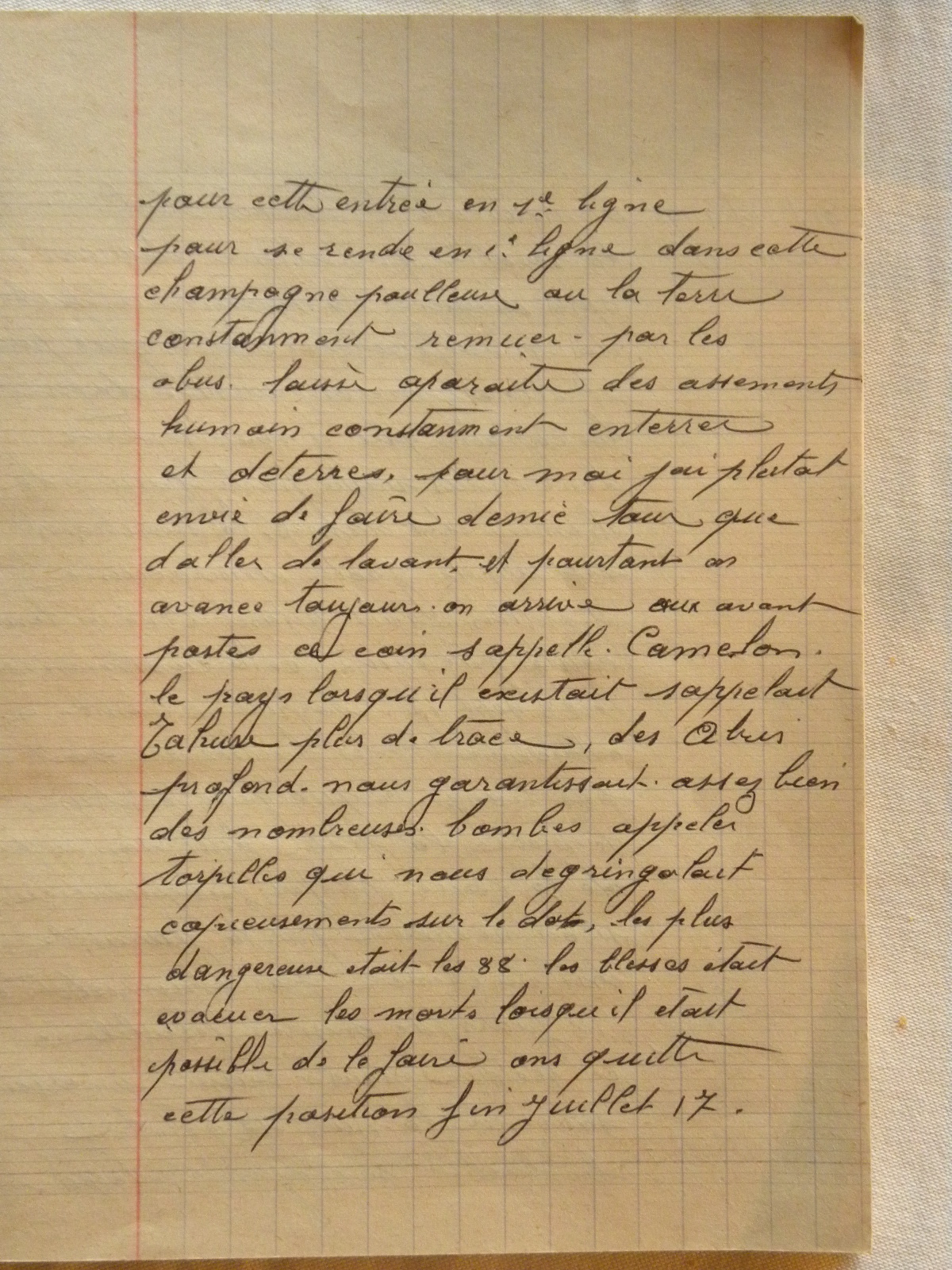
Page 3 of Albert Huet’s Diary.
Open Access Week: Sharing a Conference Presentation
Good evening everyone,
In honor of Open Access Week, I have decided to upload in ScholarSphere a conference presentation I gave in October 2011 for the Nineteenth-Century French Studies Colloquium.
The presentation is in French and is entitled Clarimonde : femme fatale, vampire décadente?
I hope you enjoy this quick read.
PS: As a reminder, here is my poster on Rachilde and Mapping Decadence I presented in April 2014 for the Penn State Graduate Exhibition.
Zembla and La Vie Online
As the managing editor of the blog 100 Digital Discoveries, I am proud two announce our two latest blog posts. The first one is dedicated to Zembla, a website devoted to Vladimir Nabokov’s life and works and the Penn State Libraries’ earliest digital humanities project. The second post deals with La Vie Online, Penn State’s student yearbooks, and allows alumni to reconnect with their past.
Un bac "humanités digitales"?
I was so surprised this morning when I turned on the radio and heard about France’s new idea: the creation of a bac “humanités digitales”. From what was said, the idea is to attract students to a new kind scholarship, to show them for instance that you can learn history using digital collections or French literature with textual analysis tools.
Behind this idea is also the thought that this kind of training will be valuable on the job market, especially for people in the humanities, who will not only bring their humanities training to their future job, but also their knowledge of the digital world (such as the terrifying “big data”).
I think this is a great idea, but we need to make sure that the basics will still be taught: students will still have to learn how to write a good essay and how to think critically.
For more information, lease to this segment on France Info.
100 Digital Discoveries
The Publishing and Curation Services Department of the Penn State Libraries is proud to announce the launch of its new blog, 100 Digital Discoveries.
The goal of this blog is to put a spotlight on the various objects, collections, and projects to which Publishing and Curation Services and other departments and libraries contribute, or have contributed, an aspect of curation expertise.
The posts will be about various topics related to our digital collections (either born digital or which have been digitized for broader access and use): a specific object we find fascinating, how a collection has been used for research/teaching, how a project came into being, the different steps it takes to digitize a collection, etc. Our hope is that there will be innumerable discoveries arising from this blog, in both the writing and the reading of it.
Check out the first two posts about the Learning as Play project and the Advertising Trade Cards collection. And don’t forget to check back often as more posts will follow soon.
"Data Driven: Digital Humanities in the Library" Conference.
The “Data Driven: Digital Humanities in the Library” Conference took place in Charleston, SC from June 20 until June 22, 2014 with over 90 attendees. It was sponsored by the South Carolina Digital Library, the College of Charleston, the Program in the Carolina Lowcountry and Atlantic World, and the Charleston Conference.
Attending this conference was made possible thanks to the generous support of the Publishing and Curation Services Department and the Pennsylvania State University library, which fully funded my trip to Charleston.
The first day was dedicated to workshops where attendees could learn more, among other things, about Omeka, a website aimed at hosting collections, exhibits, and other digital projects. In the evening, Riccardo Ferrante gave the opening keynote address entitled “Digital Humanities: A Voyage of Discovery.” Ferrante is the Information Technology Archivist and Director of the Smithsonian Institution Archives’ Electronic Records Program. His talk pointed out how important it is to think about where the Digital Humanities are now and what they can become in the future. Ferrante then turned to crowdsourcing and asked whether it can help with the creation of knowledge (the answer, he said, is yes). As an example, he mentioned the Smithsonian Transcription Center (@TranscribeSI) which has undertaken 135 projects, 97 of them completed. Registered users have the ability to view everything they have been working on which is a great way to visualize one’s productivity. That made me wonder whether working on a crowdsourced project (for instance transcribing letters) could count as a CV line. I still have no answer to this question, but I would be curious to see if any scholars (including graduate students, adjuncts, and professors) have done so in the past.
Following Ferrante’s talk, many audience members asked questions, especially in regards to crowdsourcing sources held by smaller institutions. Brian Rosenblum and Trevor Munoz asked Ferrante what can be done for smaller institutions with specialized collections that don’t get the same attention that the Smithsonian gets. How, they continued, can smaller institutions with crowdsourcing projects make their voices heard? And what can we do as scholars, librarians, students, archivists, and institutions to remedy this problem?
One other important point that was discussed during the keynote is the role of crowdsourcing projects like those undertaken by the Smithsonian Transcription Center in helping scholars, librarians, and archivists (re)discover forgotten people or groups. These projects, therefore, are extremely important, not just for scholars who might find new objects of study or answers to older questions, but also to archivists and librarians who might find more information on a person they see mentioned in their own collections. I see this as a wonderful tool to bring people together from various disciplines to collaborate and help one another. As I said on Twitter: collaboration, the creation of new knowledge, and an openness to the world — these are what Digital Humanities are about.
On Saturday morning, I attended a session dedicated to Digital Scholarship and Curation. The first talk was given by Courtney Baron and Anna-Sophia Zingarelli-Sweet on “Digital Scholarship and the Institutional Repository: Insights from the Fine Arts.” The second talk was given by Liz Milewicz and Leslie Barnes and was entitled “Innovate and Curate? Helping Collaborative Digital Humanities Research Persist Beyond the Experiment.” Finally, the last talk, “Redefining Publishing to Serve New Forms of Scholarship: A Proposal for Publishers, Librarians, and Scholars to Re-make the Publishing Process,” was given by Sylvia K. Miller.
What I learned from these talks is the importance, once again, of collaborations between scholars, librarians, and archivists, especially on DH projects. Scholars often have concerns about the longevity of digital projects and often forget that librarians and archivists can help address many of these concerns. Moreover, it is very important for scholars to think about what they want to do with their digital projects. Do they want to use them in a classroom? Do they want to publish them? In which language should it be done? Who would the target audience be? These are the questions I asked myself when I started working on my Mapping Decadence project. I started collecting data in French and originally, I planned to have the pop-ups display information in French. But since I wanted this project to be accessible to a wider audience, not just scholars in French studies, I decided to translate everything and to write the article that will accompany my project in English.
During the lunch break, Emily Gore gave the second keynote talk. Gore is the Director for Content of the Digital Public Library of America. She discussed the Digital Public Library of America (DPLA) one year after its launch as well as its future. Impressive fact: one year after its launch, DLPA has already had 9 million hits. That’s amazing. Scholars: this is such a wonderful tool to use in the classroom. There are so many opportunities to include resources from this website in your teaching. (For scholars of France and the Francophone world, we have Gallica).
In the afternoon, I attended the session Supporting, Enabling and Undertaking Digital Research: a British Library Perspective. Here, James Baker and Aquiles Alencar-Brayner talked about how the British Library supports and enables digital research. One great example is the British Library labs, where you submit your digital project in their Competition if you have innovative research ideas. Two winners are announced every year. They get to work in ‘residence’ on their project with the Labs and Library team at the British Library and are then awarded money prizes. One of the projects they helped develop in this year is a Victorian Meme Machine. Seriously, how cool is that?
The last session of the day was Cross-Campus Collaborations: Partnerships between Humanities and Library Faculty with three different talks. The first one was on “Developing Digital Scholarship Services at the Library: A Collaborative Approach to Urban Cultural Studies and Digital Humanities in Languages” by Jolanda-Pieta Van Arnhem and Benjamin Fraser. The second talk was given by Jan Blodgett, Caitlin Christian-Lamb, and Craig Milberg on “Curriculum Driven: A Liberal Arts College Archives Path to Digital Humanities.” Finally, Harriett E. Green talked about “Libraries and Digital Pedagogy: Faculty-Librarian Partnerships to Teach Digital Humanities.”
What I, as a scholar of France, found especially interesting about this session, is that, as Fraser pointed out, DH scholarship is mainly written in English. When you are teaching and using DH tools in a language class, the instruction therefore typically needs to be in English, which interferes with the teaching of a language and its practice. It is something I have seen in the classroom myself: it can be difficult to give DH guidelines to students in French when all of the scholarship is in English. It is then up to the instructor to translate, which of course is quite time consuming. This does not mean, though, that all DH projects need to be or are in English. Check out this great website that explores DH projects from around the globe.
The DH projects presented are a great way for students to discover what is being done in a library or in the archives. That is the case at Davidson College, which asks its freshmen to transcribe hundred-year old letters from former students. Not only is it a fun approach to teaching them about primary sources and the history of their new school, but it is also a great way to tell them about the usefulness of digital tools at an early stage in their college life —which, I suspect, will prove helpful to them in the long run. The example of Davidson College is also great because it shows that whether you’re working at an R1 or a small liberal arts college, in some cases, the questions you face are pretty similar: how do you teach your students new tools? How do you sustain your projects? And how do you engage your community?
The last keynote talk was given by Trevor Muñoz, the Assistant Dean for Digital Humanities Research at the University of Maryland Libraries and an Associate Director of the Maryland Institute for Technology in the Humanities (MITH). The talk was entitled “Data Driven but How Do We Steer This Thing?” He has posted the slides to his talk, which is very generous. His talk really made me think a lot about the power relations between scholars and librarians working on DH projects. I do think that being a scholar working in a library gives me a greater understanding of both sides. We should focus on creating meaningful collaborations and seeing each other as partners. A scholar who wants to work on a DH project will very likely need some help just like a librarian will need the knowledge of a scholar when creating a digital collection, for instance. It is therefore important to find the right balance for both sides.
On Sunday, I attended the session on Teaching Digital Humanities in the Library with James Baker, Helene Williams, John Russell, and Brian Rosenblum. It dealt with “the instructional roles that librarians have played (and can play) in supporting digital humanities scholarship” (conference website). What I got from this session is that graduate students tend to see the library as a safe and neutral space, in which they are allowed to experiment and fail. I also discovered this fun project: http://mydaguerreotypeboyfriend.tumblr.com/
Going to this conference was extremely beneficial to me as it allowed me to hear about DH through the eyes of librarians and archivists. Some of the questions and concerns are identical to those discussed at other DH conferences I have attended (sustainability of a project, need for a collaboration, how to teach DH, etc.). But what was striking to me was hearing the attendees talk about scholars and the way they approach working on a digital project. It seems there is still a lot of work to be done so that scholars and librarians view each other as equals – people who can mutually benefit from their collaboration. Being myself a scholar working in the library, I feel as if I am in the perfect place, hearing both sides, and trying to bridge the divide. We can talk all we want about the Digital Humanities, and its positive or negative aspects, but what we need to really focus on, I think, is making DH a great opportunity for scholars, librarians, and archivists to help, educate, and collaborate with one another.