I am delighted to have been part of the “DH for Librarians” project led by Emma Annette Wilson. Always happy to share the work I do alongside my colleague Laurie N. Taylor.
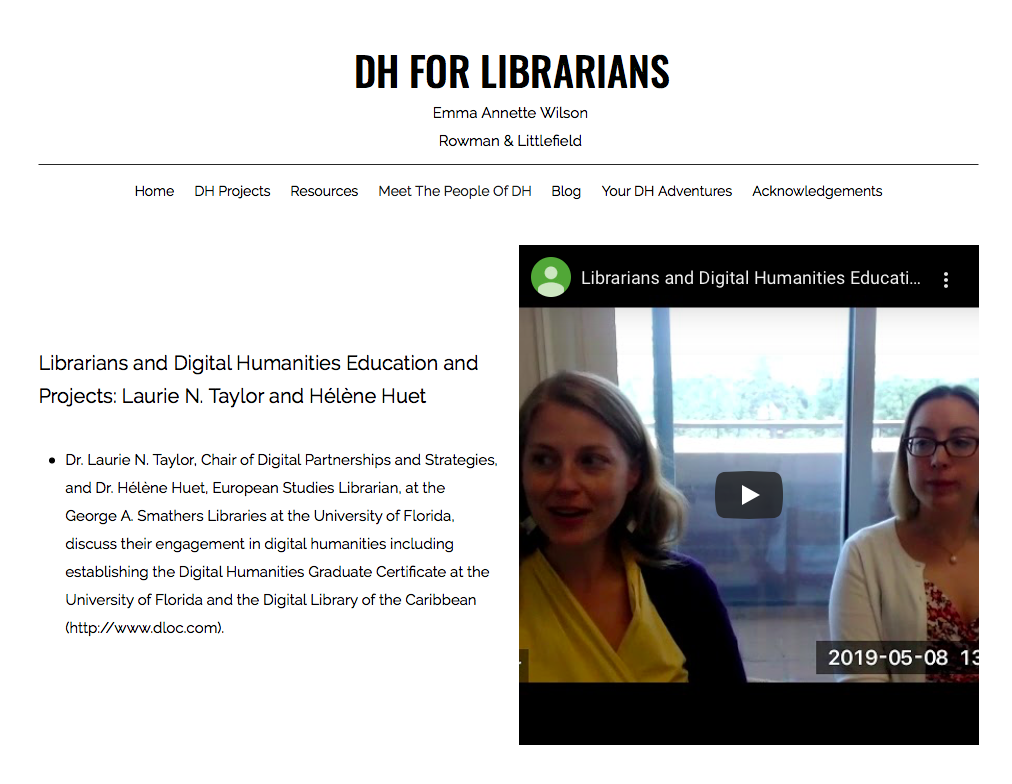
Ph.D. – European Studies Librarian – University of Florida
I am delighted to have been part of the “DH for Librarians” project led by Emma Annette Wilson. Always happy to share the work I do alongside my colleague Laurie N. Taylor.
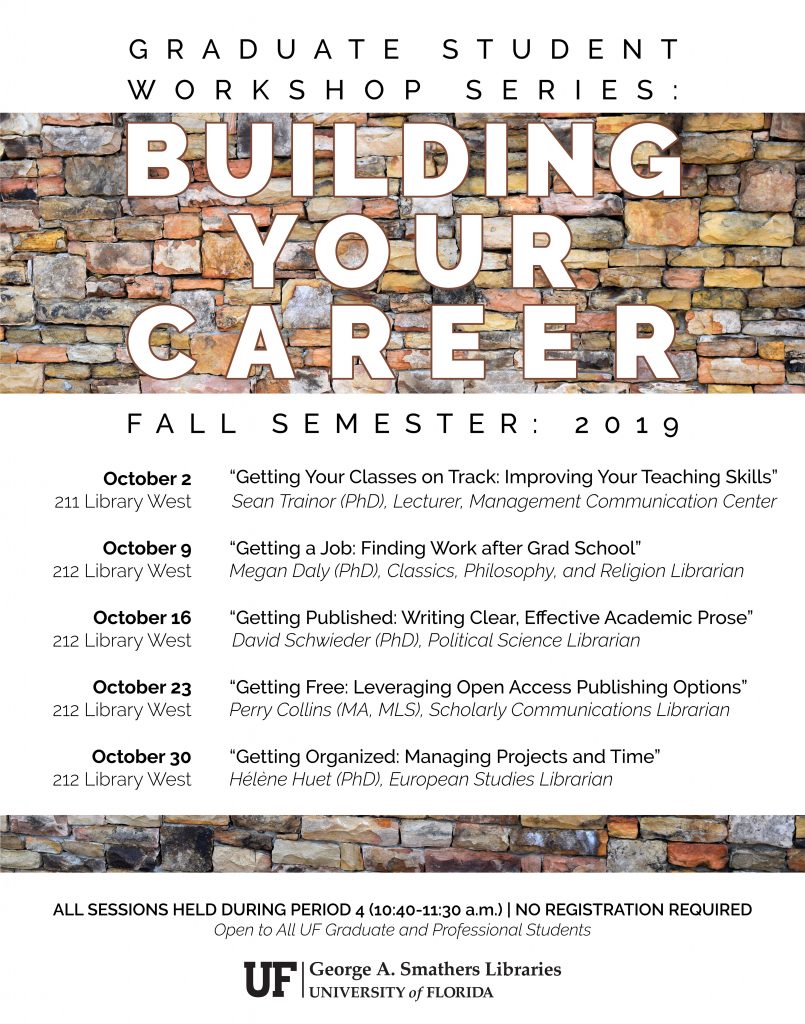
October 2 (211 Library West), “Getting Your Classes on Track: Improving Your Teaching Skills”
Sean Trainor (PhD), Lecturer, Management Communication Center.
New to teaching? Struggling to balance your teaching and research obligations? Then attend this session for some easy-to-implement tips on how to maximize your teaching effectiveness while minimizing teaching-related headaches.
October 9 (212 Library West), “Getting a Job: Finding Work after Grad School”
Megan Daly (PhD), Classics, Philosophy, and Religion Librarian
This workshop provides a brief introduction and discussion for graduate students about approaching the job market and job application process.
October 16 (212 Library West), “Getting Published: Writing Clear, Effective Academic Prose”
David Schwieder (PhD), Political Science Librarian
This session covers a set of powerful, easy-to-use techniques that will help participants write better theses, dissertations and manuscripts.
October 23 (212 Library West), “Getting Free: Leveraging Open Access Publishing Options”
Perry Collins (MA, MLS), Scholarly Communications Librarian
Are you hearing terms like “open access,” “preprint,” and “data sharing” and want to know more? The open access publishing landscape has expanded exponentially over the past two decades—this workshop will introduce options across disciplines for sharing, reviewing, and publishing open scholarship. This workshop is part of international Open Access Week.
October 30 (212 Library West), “Getting Organized: managing Projects and Time”
Hélène Huet (PhD), European Studies Librarian
This workshop will provide you with tips and tools to help you manage your time and your various projects as you navigate your graduate career.
All sessions held during Period 4 (10:40-11:30 am). No registration required. Open to all UF Graduate and Professional Students.
Welcome back (and welcome) to the University of Florida. My newsletter for Fall 2019 is out. In this newsletter, I highlight the services I provide for my patrons and new resources we have recently acquired in the UF libraries. I also provide information about the IR@UF and ORCID, quick facts about the Graduate Student Workshop Series we are hosting and our faculty and graduate carrels. Finally, I list 10 of our most recent book acquisitions.
An article I wrote with two of my UF colleagues, Suzan Alteri and Laurie N. Taylor, was published yesterday in the latest issue of Digital Humanities Quarterly. It is entitled: “Manifesto: A Life on the Hyphen: Balancing Identities as Librarians, Scholars, and Digital Practitioners.“
The work of digital humanists and librarians is often invisible to the larger communities in which they work, particularly in academia. This opinion essay by three librarian-scholar-digital practitioners explores invisible work and life on the hyphen — between the academy and the library and between the human and the digital. In this essay, we illustrate how librarian-scholar-digital practitioners can feel overworked and underappreciated, working in and with multiple fields and communities who have different and sometimes competing methodologies. Through two examples, we look at how living on the hyphen takes its toll for librarian-scholar-digital practitioners. We end our essay by detailing steps faculty and administration can take to help us solve the problem and realize the promise of digital humanities.
The George A. Smathers Libraries at the University of Florida are currently hiring two brand new and very important positions.
Student Success Librarian.
The Student Success Librarian is a year-round (12 month) tenure track faculty position that will coordinate student success support within the libraries and collaborate with student success initiatives across campus. We are seeking a service-oriented candidate who is committed to empowering undergraduate students of diverse experiences, races, ethnicities, genders, sexualities, abilities, and socioeconomic backgrounds; an innovative instructor who will develop engaging information literacy learning experiences; a creative collaborator who will coordinate and participate in campus-wide outreach efforts; and a student-centered advocate for inclusion.
Applications are due by August 20, 2019. For more information, check out the job posting: http://library.ufl.edu/pers/documents/StudentSuccessLib_PVA_Final.pdf
Diversity, Equity, and Inclusion Librarian.
Through a participatory Strategic Directions development process in 2018, the Libraries committed to better understanding and fostering a more inclusive workplace. As one element in our efforts, the DEI Librarian position will help the Libraries’ team members recognize, understand, value and embrace our differences as crucial to our communal work. As part of the development and implementation of a DEI program for the Libraries, the DEI Librarian will serve as the Libraries’ Campus Diversity Liaison (CDL), working within a network of peer positions from across the University as well as serving as a liaison within the Libraries. We seek a capacity builder who will create, in collaboration with people of diverse cultural backgrounds and origins, races, ethnicities, genders, sexual orientations, and perspectives, meaningful dialogue and change.
The DEI Librarian will participate in national dialogues within the United States and globally that promote the establishment of professional practices in libraries and programs to enhance the opportunities of minority and underrepresented groups in the library profession.
Applications are due by August 30, 2019. For more information, check out the job posting: http://www.uflib.ufl.edu/pers/documents/DEILib_PVA-FINAL_2019.pdf
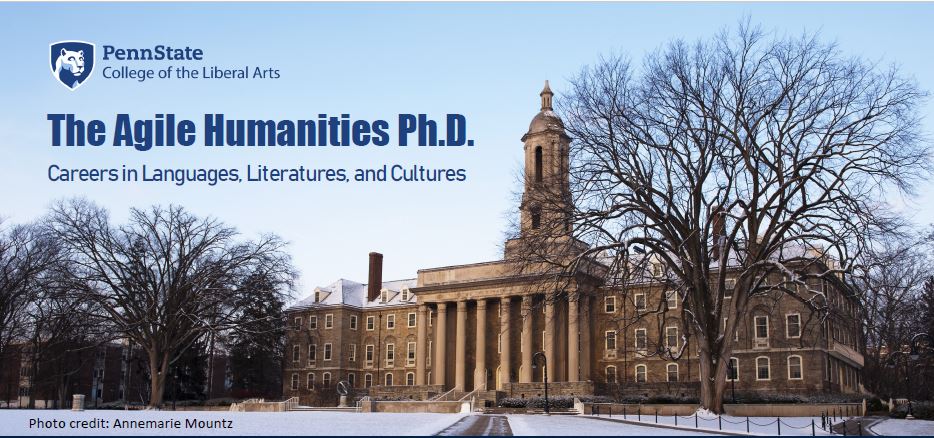
This two-day symposium will bring together seven graduates from Penn State’s School of Global Languages, Literatures, and Cultures and current doctoral students for two half-day sessions focused on the growing range of academic, academic-adjacent and non-academic careers for which a Ph.D. in languages, literatures, and cultures offers preparation. Participants from varied professions including government service, academic librarianship, academic administration, and program management will share experiences from the perspectives of both job applicants and employers. The Friday afternoon session will feature a roundtable discussion with the guest panelists followed by breakout sessions led by the panelists, organized around specific career paths. The Saturday morning session will focus on the current academic job market and will feature doctoral students with recent experience. The event aims to encourage both information-sharing and networking and frank discussion of the versatility of a humanities Ph.D. in languages, literatures, and cultures, with broader implications for other liberal arts fields.
Schedule
Friday, March 22
2:00-3:30 – Roundtable with panelists: “The Agile Humanities Ph.D.? Choices, Trajectories, Career Paths”
3:30-4:00 – Coffee break
4:00-5:00 – Breakout sessions with panelists
5:00-6:30 – Reception
Saturday, March 23
9:00-10:00 – Breakfast
10:00-12:00 – Roundtable on this year’s job market with current graduate students
12:00 – Lunch
This event has received generous co-sponsorship support from the College of the Liberal Arts, the School of Global Languages, Literatures, and Cultures, the Department of Comparative Literature, the Department of French and Francophone Studies, the Department of Germanic and Slavic Languages and Literatures, and the Department of Spanish, Italian, and Portuguese.
| Barbara Mennel Rothman Chair and Director, Center for the Humanities and the Public Sphere Associate Professor, Departments of Languages, Literatures, and Cultures, and English. Wednesday, March 20, 2019 3:30 p.m., Smathers Library, Room 100 Women at Work in Twenty-First-Century European Cinema University of Illinois Press, 2019 From hairdressers and caregivers to reproductive workers and power-suited executives, images of women’s labor have powered a fascinating new movement within twenty-first century European cinema. Social realist dramas capture precarious working conditions. Comedies exaggerate the habits of the global managerial class. Stories from countries battered by the global financial crisis emphasize the patriarchal family, debt, and unemployment. Barbara Mennel delves into the ways these films about female labor capture the tension between feminist advances and their appropriation by capitalism in a time of ongoing transformation. | |
| Looking at independent and genre films from a cross-section of European nations, Mennel sees a focus on economics and work adapted to the continent’s varied kinds of capitalism and influenced by concepts in second-wave feminism. More than ever, narratives of work put female characters front and center–and female directors behind the camera. Yet her analysis shows that each film remains a complex mix of progressive and retrogressive dynamics as it addresses the changing nature of work in Europe. Barbara Mennel’s research interests include transnational cinematic practices, feminist and queer theory, and the intersection of urban studies and film studies. She is author of four books on literature and film and two co-edited volumes, including Women at Work in Twenty-first Century European Cinema (2019). The second revised edition of her book Cities and Cinema (Routledge, 2008) is forthcoming this June. She is currently working on a director study of experimental filmmaker Su Friedrich, under contract with University of Illinois Press as well. |

POSITION VACANCY ANNOUNCEMENT
POSITION: Anthropology Librarian
RANK: Assistant University Librarian or Associate University Librarian
REPORTS TO: Associate Chair, Humanities & Social Sciences Library (Library West)
SALARY: Minimum salary at the Assistant University Librarian rank is $54,035
Minimum salary at the Associate University Librarian rank is $62,500
Actual salary will reflect selected professional’s experience and credentials
REQUISITION #: 43739
DEADLINE DATE: March 29, 2019 – applications will be reviewed as received.
Please note: this posting has specific instructions for the submission of application materials. Failure to submit required documents may result in the application not being considered.
JOB SUMMARY
The Anthropology Librarian is a year-round (12 month) tenure track library faculty position responsible for the overall development, management and coordination of the George A. Smathers Libraries resources in all formats for archaeology, and biological, cultural and linguistic anthropology. The position supports the University’s academic programs including the Department of Anthropology as well as interdisciplinary programs supported by the College of Liberal Arts and Sciences. Responsibilities include analyzing the University’s programs in anthropology, collaborating with librarians and academic faculty to establish collection profiles, selection guidelines, and preservation, location and cataloging priorities; and evaluating existing collection strengths and current collecting intensities. Collaborates with other employees to provide support in the broader area of the social sciences, especially interdisciplinary areas. This position manages specialized subject area reference services, library instruction, and online database services.
The Smathers Libraries encourage staff participation in reaching management decisions and consequently the Anthropology Librarian will serve on various committees and teams. To support all students and faculty, and foster excellence in a diverse and collaborative society, the Libraries are actively seeking candidates who bring culturally-rich lived experiences to work with individuals of diverse backgrounds, experiences, races, ethnicities, genders, gender identities, sexual orientation, and perspectives. The Smathers Libraries recently created a new strategic direction focused on ensuring that the Libraries are a safe, supportive and welcoming learning environment for all users and on focusing engagement efforts to diverse populations within the University and local community. The Anthropology Librarian will pursue professional development opportunities, including research, publication, and professional service activities in order to meet library-wide criteria for tenure and promotion.
RESPONSIBILITIES:
– Develops relationships with appropriate academic faculty, including those in the Department of Anthropology and interdisciplinary programs supported by the College of Liberal Arts and Sciences.
– Keeps informed of the development of academic programs and faculty interests to ensure that the Libraries’ collections and services support curriculum and research needs, and informs clientele about relevant Libraries’ issues.
– Responsible for advanced reference and research consultation in support of anthropological studies, including the development of LibGuides and other online resources.
– Defines goals, establishes objectives, plans and manages budgets, and coordinates collection development activities with other subject specialists, and librarians, with respect to resources for the anthropological studies, and related collections.
– Analyzes the anthropology collection development program and activities and provides reports, strategies, assessments, and studies or surveys as required. Participates in the Humanities and Social Sciences general reference program.
– Participates in outreach and instruction programs using traditional classroom and active learning methods and innovative educational technologies.
– Supports diversity, equity and inclusion efforts as part of the Libraries Strategic Directions.
– Participates in appropriate professional development and continuing education endeavors and engages in scholarly service and research resulting in publication.
– Liaises and collaborates with faculty, students, researchers and other departments to further library scholarship initiatives and partnerships.
-Performs scholarly research and provides service at the institutional and professional levels as related to assignment and in accordance with tenure and promotion criteria
– Participates in Library fundraising efforts and grant projects.
QUALIFICATIONS:
Required:
– Master’s degree in Library or Information Science from an ALA-accredited program, or other relevant advanced degree in subject specialty with a minimum of two years of library work experience.
– For appointment at the Associate University Librarian rank, eight years of relevant experience
– Familiarity with scholarly literature of anthropology.
– Excellent analytical and organizational skills.
– Ability to work both independently and collaboratively with faculty, students, administrators, and the general public.
– Excellent verbal and written communication skills as well as effective presentation skills.
– Commitment to including individuals of diverse backgrounds, experiences, races, ethnicities, gender identities, sexual orientation, and perspectives in research, teaching, service and other work.
– Initiative, flexibility and the ability to adapt to a complex, rapidly changing academic environment.
– Competence with information technologies and demonstrated effectiveness in integrating technology with traditional services and resources.
– Competence with office technology and willingness to learn new technology.
– Strong potential for meeting the requirements of tenure and promotion.
Preferred:
– Advanced degree in anthropology or related field.
– Undergraduate degree in anthropology or other relevant discipline, or extensive work experience in a relevant subject area.
– Experience providing reference and/or instructional services related to anthropology and social sciences in an academic or research library environment.
– Sound knowledge of collection management, reference, and instructional practices and standards.
– Experience in evaluating print and online resources.
– Experience managing collections in an academic or research library.
– Proficient in the creation of web pages and web based materials
– Experience in digital scholarship and data curation.
THE UNIVERSITY OF FLORIDA
The University of Florida (UF) is a major, public, comprehensive, land-grant, research university. The state’s oldest and most comprehensive university, UF is among the nation’s most academically diverse public universities and won the 2018 Senator Paul Simon Award for Comprehensive Internationalization.
UF was ranked 9th among public universities in Forbes’ “America’s Best Employers 2015” and 8th among “Top Public Schools” in U.S. News and World in 2018. UF has a long history of established programs in
international education, research and service. In 2013 the Florida Legislature designated UF as the state’s preeminent institution which grew into an opportunity to achieve national and international recognition for
the University’s work in serving students and the world. It is one of only 17 public, land-grant universities that belong to the Association of American Universities. UF traces its beginnings to a small seminary in 1853 and is now one of the largest universities in the nation, with more than 50,000 students. For more information, please consult the UF homepage at http://www.ufl.edu.
UNIVERSITY OF FLORIDA LIBRARIES
The libraries of the University of Florida form the largest information resource system in the state of Florida. The UF Libraries consist of seven libraries on the Gainesville campus and three off-campus facilities; six of the campus libraries, and all of the off-site facilities, are in the system known as the George A. Smathers Libraries at the University of Florida. The remaining library is the Lawton Chiles Legal Information Center. Collectively, the UF Libraries (the Smathers Libraries and the Legal
Information Center) hold or provide access to over 6 million print volumes, 8.1 million microfilms, 1.5 million e-books, over 145,000 full-text electronic journals, 827 electronic databases, 1.3 million documents and 1.4 million maps and images. The UF Libraries have built a number of nationally significant research collections, including the Latin American, Judaica, Florida History, Children’s Literature, and Maps and Imagery collections. The UF Libraries are a member of the Association of Research Libraries (ARL), the Center for Research Libraries (CRL), and the Association of Southeastern Research Libraries (ASERL). The library staff consists of
more than 300 FTE librarians, technical/clerical staff and student assistants. The organizational chart is available at http://www.uflib.ufl.edu/orgchart.pdf.
The George A. Smathers Libraries are strong advocates for inclusion and intellectual freedom. The Libraries’ commitment to both is articulated in the Inclusion Statement and Intellectual Freedom Statement, both of which are posted at http://cms.uflib.ufl.edu/InclusionAndIntellectualFreedom.
HUMANITIES AND SOCIAL SCIENCES LIBRARY (Library West)
The Humanities and Social Sciences Library (Library West) is the largest branch library on the UF campus, with 17 faculty and 13 staff members, seating for 1,600 patrons, and 217 public computers, including iPads and other circulating technologies. Last year, Library West received over 1.2 million visitors. Renovated in 2006, the branch offers 18 group study rooms, a student video production space, faculty and graduate carrels as well as a limited-access floor for graduate students. One classroom is available with 19 computers for hands-on instruction. The Scott Nygren Digital Scholars Studio is a flexible space that allows seats to be arranged for individual or group projects, or auditorium style for presentations/workshops. Within the branch, there are four functional units: Research Assistance, Instruction and Outreach, Collections, and Circulation; these units are managed by coordinators who oversee the daily functions. See the organizational chart for current structure of the department.
COMMUNITY
Gainesville, Florida and the surrounding community are home to approximately 257,000 people and both the University of Florida and Santa Fe College. Situated just over an hour from the Gulf of Mexico and the
Atlantic Ocean, the city is surrounded by over 40 nature parks, including many spring-fed lakes and rivers.
In 2015, Gainesville was named the “Best Midsize College City in America” by WalletHub and ranked no.7 on Livability.com “Top 10 College Towns.” Gainesville is known as an innovative municipal government and an innovative city. Gainesville continues to receive national recognition as a top-rated city. Some of Gainesville’s accolades are listed at the Gainesville Awards and Recognition link. The Guide to Greater Gainesville combines award winning photography and compelling articles that capture all of the reasons for calling Greater Gainesville your next home. The area has numerous cultural institutions and is a haven for sports fans. Jacksonville, Orlando, Tampa, Tallahassee, and St. Augustine are all within a two-hour drive. Gainesville is an affordable city and area to live in – using a cost of living calculator you can compare cities across the United States. See how affordable Gainesville really is.
BENEFITS
Vacation days, paid holidays, and sick leave days; retirement plan options; insurance benefits; tuition fee waiver program; no state or local income tax. Prospective employees should review the information about employment and benefits at UF available at http://hr.ufl.edu/benefits/. UF offers a comprehensive new online benefits tool called ALEX to help employees and prospective employees review benefit choices at UF.
APPLICATION PROCESS
To apply, submit 1) a cover letter detailing your interest in and qualifications for this position; 2) a written essay on this topic (in 250 words or less) “As the Anthropology Librarian, how would you reach out to students and faculty to promote library programs and services?”; 3) your current resume or CV; and 4) a list of three references including their contact information (address, telephone number, and email). Apply by March 29, 2019 (applications will be reviewed as received). Submit all application materials through the Jobs at UF online application system at Requisition 43739. Failure to submit the required documents may result in the application not being considered. If you have any questions or concerns about this process please contact Bonnie Smith, George A. Smathers Libraries Human Resources Office, at bonniesmith@ufl.edu.
Final candidate will be required to provide official transcript to the hiring department upon hire. A transcript will not be considered “official” if a designation of “Issued to Student” is visible. Degrees earned from an education institution outside of the United States are required to be evaluated by a professional credentialing service provider approved by National Association of Credential Evaluation Services (NACES), which can be found at http://www.naces.org/.
AFFIRMATIVE ACTION/EEO
The University of Florida is an Affirmative Action, Equal Opportunity Employer and encourages applications from women and minority group members. We are dedicated to the goal of building a culturally diverse and pluralistic environment; we strongly encourage applications from women, members of underrepresented groups, individuals with disabilities, and veterans. As part of the application process, applicants are invited to complete an on-line confidential and voluntary demographic self-disclosure form. This information is collected by the University of Florida’s Office of Human Resources to track applicant trends and is in no way considered by the Smathers Libraries in the selection process.
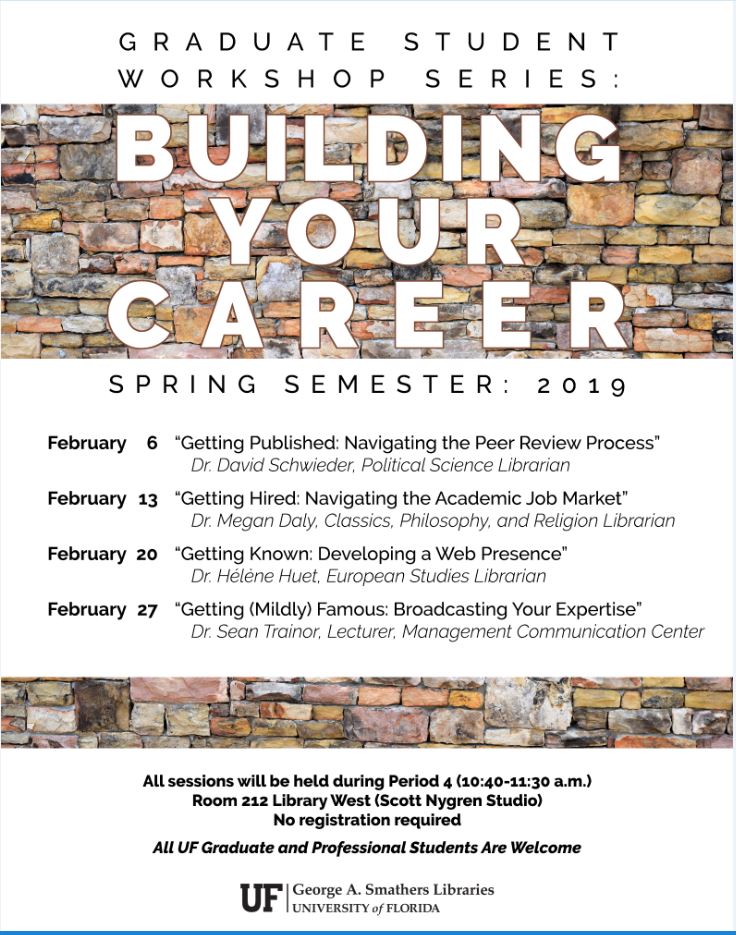
Getting Published: Navigating the Peer Review Process (Feb. 6). This workshop provides an “authors-eye view” of the peer review process. Covered topics include selecting appropriate journals, understanding editors’ goals, formatting your manuscript, responding to reviews, and more.
Dr. David Schwieder, Political Science Librarian.
Getting Hired: Navigating the Academic Job Market (Feb. 13). This workshop provides a brief introduction and discussion about approaching the academic job market and application process in the last year of graduate school.
Dr. Megan Daly, Classics, Philosophy, and Religion Librarian.
Getting Known: Developing a Web Presence (Feb. 20). This workshop provides an overview of how to create and maintain a professional web presence by using personal websites, digital projects, and social media platforms like Twitter or Facebook.
Dr. Hélène Huet, European Studies Librarian.
Getting (Mildly) Famous: Broadcasting Your Expertise (Feb. 27). This workshop provides tips on how to pitch an op-ed and start a podcast: two tried-and-true techniques for making anonymous graduate students into publicly-recognized experts in their fields.
Dr. Sean Trainor, Lecturer, Management Communication Center.
All sessions are Period 4 10:40-11:30 a.m.
Room 212 Library West (Scott Nygren Studio)
No registration required
All UF Graduate and Professional Students Are Welcome
Hello everyone. I am pleased to announce that my book chapter “Improving Graduate Students’ Research Skills: The Graduate Student Research Series at the University of Florida.” is out in the book Transforming Libraries to Serve Graduate Students.
Interested in buying the book? You can find it here: https://www.alastore.ala.org/content/transforming-libraries-serve-graduate-students.
Thanks to the editors Crystal Renfro and Cheryl Stiles for their hard work.