Category Archives: Academia

CFP: European Studies Research Forum American Library Association Annual Conference, New Orleans, June 21-26, 2018

CFP: European Studies Research Forum
American Library Association Annual Conference, New Orleans, June 21-26, 2018

The ACRL European Studies Section will host its annual European Studies Research Forum at the ALA annual conference in New Orleans on Sunday, June 24th, from 8:30 to 10:00 a.m.
The ESS Research and Planning Committee invites proposals for presentations on research, including digital projects, related to any part or language of Europe. Topics do not need to be library-related.
The committee will consider proposals on research in-progress or recently completed projects.
Proposals must include:

  • Name and brief bio of the presenter(s)
  • Tentative title and 200-word abstract

The committee will evaluate the proposals based on the clarity of the topic and quality of the abstract.
Presentations will be limited to 15 minutes each for 3 presentations, followed by time for questions. The forum will offer the presenters an opportunity to discuss their research in an informal setting.
Please submit your proposal via email to the chair of the ESS Research and Planning Committee, Ms. Téa Rokolj (trokolj@uottawa.ca). The deadline for proposal submissions is March 31st.
The proposals will be reviewed by the members of the committee who will choose 3 proposals for the forum.  All persons who submit a proposal will be contacted soon after the committee makes its decision by mid-April at the latest.

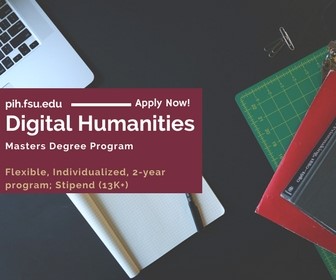
FSU Digital Humanities Graduate Program – deadline March 30, 2018; tuition waiver and stipend

pic
What is digital humanities?
Digital humanities embraces a wide variety of activities that, in different ways, bring together data science, computing, data curation, and humanistic study. Work in the digital humanities can range from digital exhibitions in museums and libraries, to the work of scholars using computers to analyze literature and art, to study of and engagement with social media and social networks, to the practice of digital publication and media.
Why should I pursue a degree in digital humanities?
Students of digital humanities can apply their skills and expertise in universities and cultural heritage institutions or in a variety of roles in non-profit or private industry which require a combination of both traditional “soft” skills in the liberal arts and the digital skills of the 21st century. Though some students will come to digital humanities as a way to prepare for pursuing a Ph.D. in a discipline and in order to do research specifically in digital humanities, others will find digital humanities a pathway to humanistic careers well beyond the academy. Students will find in digital humanities the tools for engaging with humanities in a new and different way than they had before.
What is the Master’s degree program like?
FSU’s digital humanities MA degree is a 2-year degree hosted in the Program in Interdisciplinary Humanities. The program is highly flexible and individualized to suit each student’s chosen specialty within the large field of possibilities open to digital humanists. There are a series of core classes where students learn essential digital humanities skills for data analytics (DH 1: Humanities Data), data curation (DH 2), and for communicating and teaching (Digital Pedagogy). Students are also part of a growing and vibrant community of digital humanities scholars across many departments and schools of the university, including the Office of Digital Research in the University Libraries and the Digital Scholars group sponsored by the History of Text Technology Program in the Department of English. Beginning in 2018, PIH will host its own digital humanities workshop series. A collaborative digital humanities lab will start work in the coming year as well.
How much does it cost?
All students in the program are fully funded. Students are provided with a full stipend (13K +) and tuition waiver in exchange for service as teaching assistants and, in the second year of study, as instructors of record for an undergraduate course.
Questions?
For more information, contact the director of the graduate program, Dr. Allen Romano, at aromano@fsu.edu.
Information can also be found on the website, http://pih.fsu.edu, under “Program”
To Apply:
Visit http://admissions.fsu.edu/graduate/
The program in digital humanities is open to students from all majors, including especially all humanities disciplines, library or information studies, and any computing disciplines.
Applications require a statement of purpose, 3 letters of recommendation, and a sample of written or (if applicable) digital work.
Application deadline is March 31, 2018.

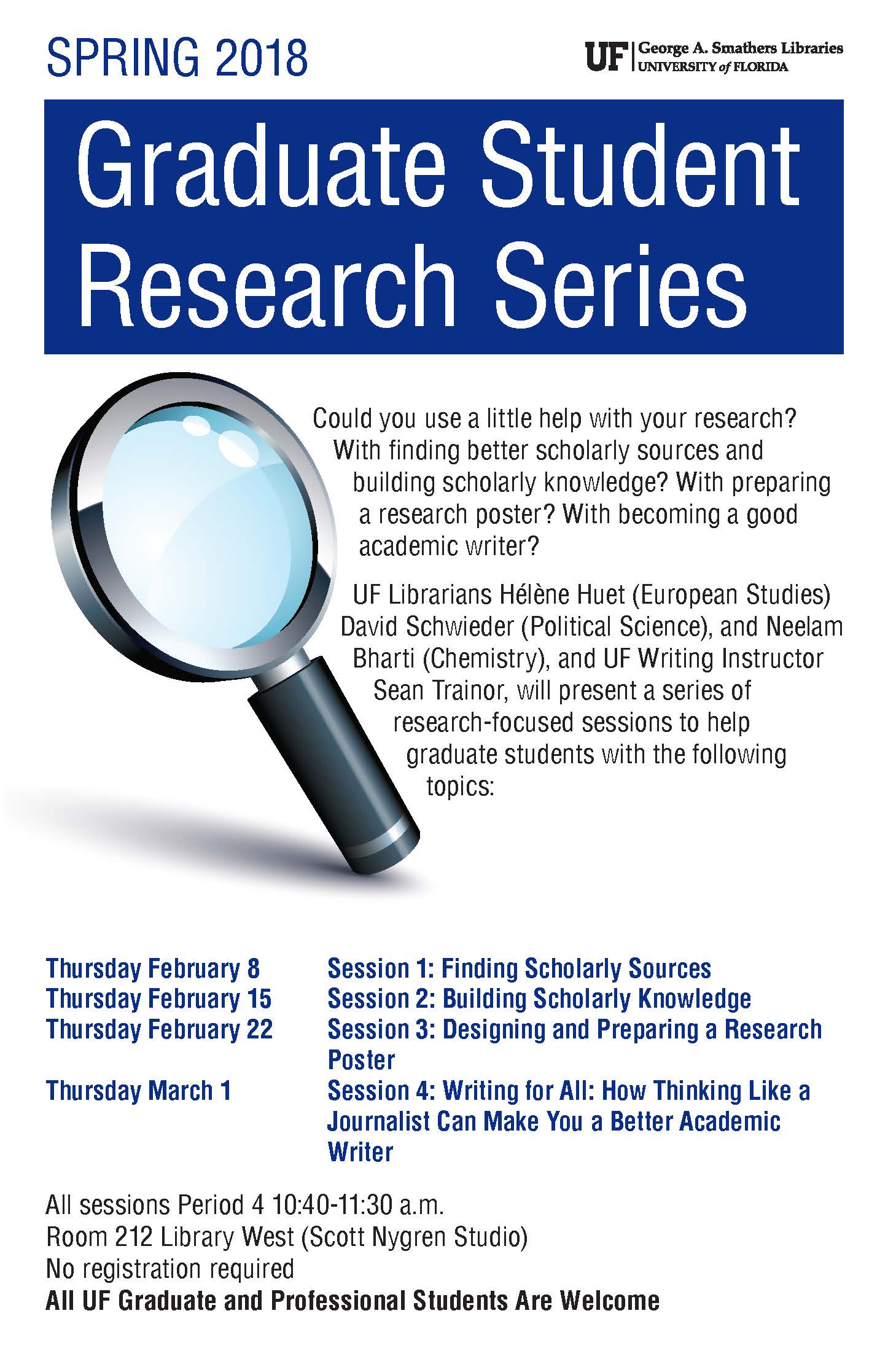
Graduate Student Research Series at UF Spring 2018

Could you use a little help with your research? With finding better scholarly sources and building scholarly knowledge? With preparing a research poster? With becoming a good academic writer?
UF Librarians Hélène Huet (European Studies), David Schwieder (Political Science), and Neelam Bharti (Chemistry), and UF Writing Instructor Sean Trainor, will present a series of research-focused sessions to help graduate students with the following topics:
Thursday February 8         Session 1: Finding Scholarly Sources
Thursday February 15       Session 2: Building Scholarly Knowledge
Thursday February 22       Session 3: Designing and Preparing a Research Poster
Thursday March 1             Session 4: Writing for All: How Thinking Like a Journalist Can Make You a Better Academic Writer
All sessions Period 4 10:40-11:30 a.m.
Room 212 Library West (Scott Nygren Studio)
No registration required
All UF Graduate and Professional Students Are Welcome
 
Grad-Student-Research-Series8x11

Call for Proposals: International Studies/Digital Humanities Symposium at the University of North Florida

On March 9, 2018, the University of North Florida will host a one–day symposium examining intersections between international studies and the digital humanities. This event is cosponsored by the UNF International Studies Program, the UNF Digital Humanities Initiative (DHI), and the UNF Center for Instruction and Research Technology (CIRT).
We will begin with a panel discussion (noon–1:15 PM, Building 58W/Room 3703) addressing the implications of digital tools and methodologies for how we understand problems in the world today, interact across cultural boundaries, and deal with matters of cultural heritage in a globalized world. Our panelists will be Crystal Andrea Felima, CLIR Postdoctoral Fellow in Caribbean Studies Data Curation, George A. Smathers Libraries, University of Florida; Josh Gellers, assistant professor of political science, University of North Florida; Hélène Huet, European studies librarian, University of Florida, and vice–chair, Florida Digital Humanities Consortium; Barry Mauer, associate professor of English and director, Texts and Technology Ph.D. program, University of Central Florida; and Tiffany Earley–Spadoni, assistant professor of history, University of Central Florida.
This discussion will be followed by an interactive showcase of digital projects (1:30–2:45 PM, Building 58W/Rooms 3804–3806) that are international in nature or that involve methodologies that may be applicable to the interdisciplinary field of international studies.
Lastly, we will hold an open conversation about opportunities for statewide collaboration on Digital Humanities endeavors (3:00–4:00 PM, Online Learning Laboratory, Building 10/Room 1102).
As part of the 1:30–2:45 showcase, we invite students, faculty and staff from UNF and other regional institutions and universities to present on digital projects, at any stage of development. To propose a project, please send a document with the following information to Clayton McCarl (clayton.mccarl@unf.edu), director of the UNF International Studies Program, by February 16, 2018: 1) full title of poster/presentation; 2) names of all participants, with academic/professional titles (or major/program of study for students); 3) a description/abstract of the material to be presented (150–250 words); 4) name of faculty mentor or project leader, where applicable, and 5) an explanation of any special needs regarding technology or equipment.

CFP: 2018 IFLA International News Media Conference

2018 IFLA International News Media Conference
“When Risk becomes Real, Preserving News becomes Critical”
Organized by the IFLA News Media Section (http://www.ifla.org/news-media)
Dates
18-20 April 2018
Location:
George A. Smathers Libraries, University of Florida, Gainesville, Florida, USA
Conference website:
URL will be posted on the IFLA News Media Section website when available
Theme & sub-themes:
As the world has seen increasing disasters that threaten entire communities, preservation of the identity of those communities as revealed through their newspapers becomes imperative. From earthquakes in Mexico to hurricanes and fires in the United States, to problems of publisher inability to manage large news archives, libraries can step in to assist communities with preservation solutions. Libraries can also save community and special-interest newspapers whose content has historically been underrepresented in mainstream circles. As news collections age, preservation solutions are increasingly pressing. Digital preservation, with infrastructure spread across multiple locations, offers many possibilities to assist communities under threat of natural disaster or to assist publishers in need of collection management solutions and to prevent loss of collection in the event of disasters.
This year, the International News Media Conference seeks proposals related to how digital preservation of news can help or has helped at-risk communities. Proposals should address the main theme and related topics, including but not limited to:
● Models of E-Deposit to Assist Publishers in Preservation
● Collecting Strategies and Legal Deposit
● Preservation/Legal Advocacy Efforts on a Local Level
● Role of Library as a News Preservation Leader
● News Preservation Practices
● Digital Preservation Infrastructure
● Relationships with Publishers
● Collecting Strategies in Local and Regional Libraries
● Disaster Preparedness in Digital News Collection Preservation
● Disaster Management Case Studies in News Preservation
● Preservation of Underrepresented Community and Special-Interest News Media
Other proposals relevant to the main conference theme will also be considered.
Submission Guidelines
Proposal abstracts must be submitted by 26 January 2018, must be in English, and should clearly include:
● Title of proposed paper
● Abstract of proposed paper (no more than 300 words)
● Name(s) of presenter(s) and position(s) and/or title(s)
● Employer / affiliated institution
● Contact information including email address and telephone number
● Short biographical statement(s) of presenter(s)
Proposal abstracts should be submitted as MS Word files to all conference committee members:
● Mary Feeney (mfeeney@email.arizona.edu)
● Ana Krahmer (ana.krahmer@unt.edu)
● Kopana Terry (kopana.terry@uky.edu)
● Patrick Reakes (pjr@uflib.ufl.edu)
● Anke Winsmann (winsmann@suub.uni-bremen.de)
Selected presenters will be notified by 5 February 2018. To discuss any matter relating to this Call for Papers, please contact the conference committee members listed above.
Accepted papers
● Complete accepted papers should be 3000-6000 words in length and be an original submission not published elsewhere.
● Complete accepted papers and accompanying presentation slides must be submitted by 6 April 2018.
● Final papers should be written in English.
● The papers will be made available on the Conference Website and the News Media Section Website under the Creative Commons Attribution 4.0 license.
● Approximately 15-20 minutes will be allowed for the presentation of the paper.
Registration
Registration information will be posted on the Conference Website at the beginning of 2018.
Important dates
26 January 2018 Proposal abstracts due
5 February 2018 Acceptance notices sent to authors
12 February 2018 Start of registration
6 April 2018 Completed papers and presentations submitted
18-20 April 2018 Conference
Please note
The Programme Committee regrets that it has no funding to assist prospective authors, and the submission of an abstract must be on the understanding that the costs of attending the conference including registration, travel, accommodation, and other expenses, are the responsibility of the presenters of the accepted papers, or their institutions. No financial support can be provided by IFLA, but a special invitation can be issued to authors.

Digital Scholarship at UF Workshop, February 2, 2018

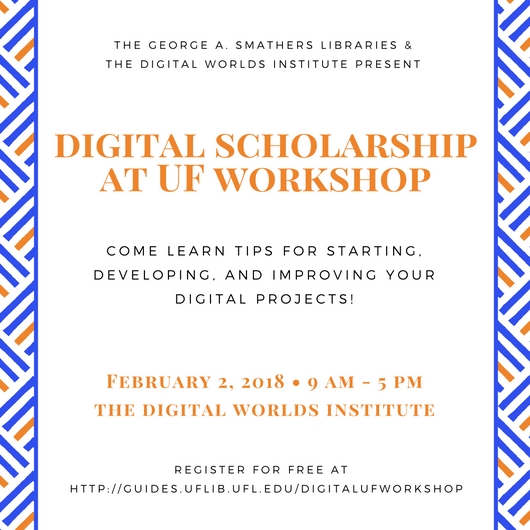
I am pleased to invite you to the Digital Scholarship at UF Workshop which will take place at the Digital Worlds Institute on February 2, 2018 from 9am to 5pm.
During this day-long event you will be able to attend three workshop sessions focused on tools and tips to help you start, develop, or improve your digital projects.
The sessions are as follows:

  • 3D Data Acquisition and Dissemination
  • 3D Printing and Augmented Reality with Aurasma
  • Best Practices for Project Management & Collaboration

Following the three sessions, we are also hosting a Digital Project Showcase where members from the UF community are invited to present their digital projects.
As you will see on the registration form (https://ufl.qualtrics.com/jfe/form/SV_3jBZ3E1SniaRPGB), you can decide to register for the Workshop Series and/or the Digital Showcase. Registration is free and lunch will be provided.
Please note that the registration for the workshop series is capped at 50 attendees and the registration for the showcase is capped at 20 presenters. If you plan on presenting your digital project during the showcase, we recommend you bring your own laptop if possible, though we will be able to provide up to 12 workstations if needed.
You can find more information about the workshops and the schedule at this link: http://guides.uflib.ufl.edu/digitalufworkshop.
Please email Hélène Huet if you have questions: hhuet at ufl dot edu
This event is sponsored by a George A. Smathers Libraries Strategic Opportunities Grant and the Digital Worlds Institute.
Digital Scholarship Workshop

Elegance of Science – enter by December 20th

Dear UF Community,
The Elegance of Science Contest is an art competition highlighting the link between art and science. We invite UF faculty, staff and students to submit artwork that blends science and art together. This year we are also accepting video entries.  Winners and select contestants will have their artwork displayed on the walls of the Marston Science Library and the Florida Museum of Natural History.
All entries must be received by December 20, 2017 to be considered.
Prizes include:

  • 1st Prize $150
  • 2nd Prize $100
  • 3rd Prize $50

For more information on contest rules, past entries, and official entry form, please visit http://www.flmnh.ufl.edu/elegance-science/home/ 

Humanities PhDs at Work: Career Paths in Librarianship. Video Online.

Back in September, my colleagues and I gave a talk at UF entitled: “Humanities PhDs at Work: Career Paths in Librarianship.” Our talk was filmed and the video is now available online.
As a reminder, here is the description of the talk:
Hélène Huet, Megan Daly, and Jessica Aberle are assistant librarians at the George A. Smathers Libraries. Though each presenter received a doctorate from their respective fields in the Humanities, Huet, Daly, and Aberle all chose to transition into the field of librarianship. If you are curious about the work that librarians undertake and whether a career in an academic library might be a good fit for you, this presentation will offer guidance. They will speak about their roles in the library and provide a brief overview of their work, followed with a discussion of their different career trajectories and the hurdles they encountered along the way. Then they will explain their decisions to pursue librarianship and why they love their work. Finally, they will provide resources and advice to those interested in libraries, archives, and information science.

2018 UF Conference on Comics and Graphic Novels "ImageTech"

2018 UF Conference on Comics and Graphic Novels
“ImageTech”

On April 6th-8th, 2018, UF will be hosting its 15th annual Conference on Comics and Graphic Novels, “ImageTech: Comics and Materiality” in Gainesville, Florida.

Call For Papers

The Graduate Comics Organization at the University of Florida invites applicants to submit proposals to the 15th UF Conference on Comics and Graphic Novels, “ImageTech: Comics and Materiality.” The conference will be held from Friday, April 6 through Sunday, April 8, 2018.
The medium of comics has always prompted comics creators to work in concert with, and push against, the technologies through which their works are produced and distributed. As print and digital technologies have become more sophisticated, accessible, and affordable, some comics creators have embraced innovative digital technologies, while others prefer pen and ink on paper. From the meticulous series of woodblock prints, to the humble black-and-white photocopied zine, to the decade-long online epic, comics are fundamentally concerned with technologically-determined formats and materiality.
The goal of this conference is to not only explore relationships among comics and various technologies, but to interrogate the digital/analog divide in comics creation and scholarship. How does form dictate content, and vice versa? How do digital platforms impact engagement and accessibility? How do changes, improvements, and advances in technologies push comics creators and scholars to reevaluate our understanding of comics as a medium? Why do some comics creators deliberately adhere, or return, to analog technologies? In short: how do we understand and approach the material considerations of comics?
Possible topics include, but are not limited to:

  • Digital comics (comics created and/or hosted/distributed digitally)
  • Print forms and “legitimacy” (monetization, privileged status of print)
  • Comics thematically or visually concerned with technologies (steampunk, cyberpunk)
  • Comics incorporating elements of other media (flash animation, animated gifs)
  • Augmented Reality (AR) and Virtual Reality (VR) comics
  • Comics made using unusual/older technologies (wood-block prints, paper cut-outs, collage, found materials) and/or creators’ use of disparate technologies
  • Zines or other periodicals that incorporate comics
  • Transitions in specific comics series from print to digital or from digital to print (potential problems/losses, transitioning forms as “translation,” introduction or removal of page turns and/or gutters)
  • Impact of social media on proliferation of image-texts (reblogs, memes, remixes, fandom/fan art, fan/composer dialogues)
  • Format and accessibility (hosting platforms, open source vs. paywalls, ads, digital copying, replication/reproduction, coding, easter eggs)
  • Comics as a format for critical scholarship

Presentations should be 15-20 minutes in length and must be delivered in English. “ImageTech” also invites creative projects related to the conference theme. Discussion panels from multiple presenters coordinated around a central topic or theme are welcome. Proposals of 200-300 words, plus a short bio and A/V requirements, should be submitted to gco@english.ufl.edu by December 15th, 2017.