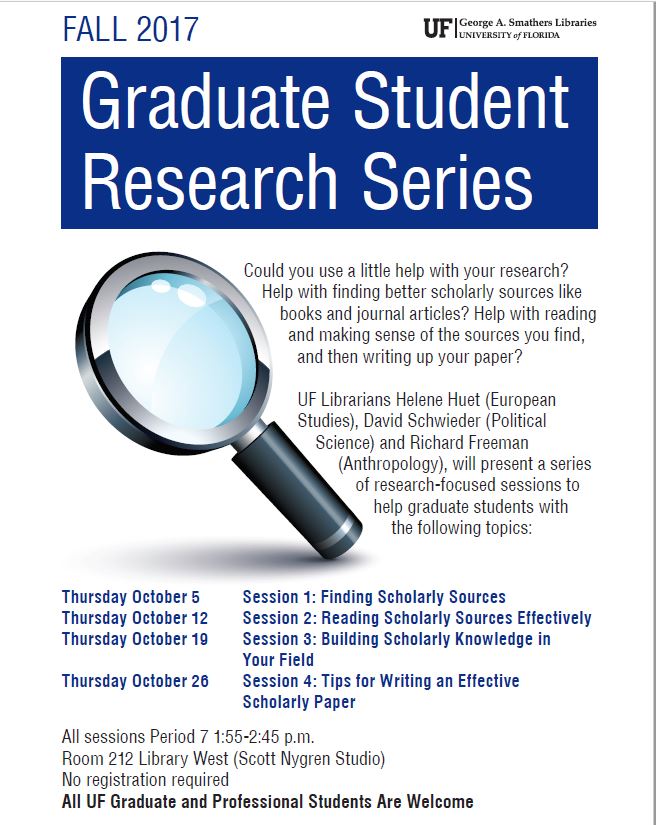
Our Graduate Student Research Series is back this semester. Come learn about finding scholarly sources and what to make of them to write an amazing paper/article/dissertation. We have plenty of tips and advice to offer.
Category Archives: Library
New Position: Digital Scholarship Associate – Library Associate 2
POSITION VACANCY ANNOUNCEMENT
POSITION: Digital Scholarship Associate – (Library Associate 2)
REPORTS TO: Associate Chair, Humanities and Social Science Library (Library West)
SALARY: $39,529 annual salary; Actual rate will reflect experience and credentials
REQUISITION #: 503537
DEADLINE DATE: September 12, 2017
JOB SUMMARY
The Digital Scholarship Associate (DS Associate) ensures coordinated and consistent activities for instruction and outreach in Library West, especially in regards to the new and expanded needs for support with digital humanities and digital scholarship. The DS Associate is responsible for coordinating and supporting Library West’s web and social media presence, the Scott Nygren Scholars Studio, trainings and activities related to digital humanities and digital scholarship as centered in Library West and across the Libraries, and in providing support to academic faculty collaborating with the Libraries on digital humanities efforts. Each week, the DS Associate will spend 10 hours in the Scott Nygren Scholars Studio, a dynamic new digital humanities and scholarship lab, to assist and/or advise faculty, staff, and students of the UF community on digital projects in collaboration with the Libraries and to hold open hours for the Studio for drop-in visitors. The DS Associate will become an expert on using the technology and software in the Studio, and is responsible for planning, coordinating, and providing training on software and technology located in and accessible from the Studio.
The DS Associate will also serve as a member of the instruction and outreach team to provide reference and instructional services. The person in this position will perform research assistance duties such as staffing the Research Assistance desk and Ask-A-Librarian. The DS Associate also participates in state and/or national conferences on an annual basis.
RESPONSIBILITIES
Digital scholarship support
– Manages the Scott Nygren Scholars Studio (Library West 212), maintaining the space and technology.
– Schedules and holds lab hours in the Studio for 10 hours each week.
– Collaborates with librarians interested in digital humanities and closely with the Instruction & Outreach Coordinator.
– Demonstrates understanding and works toward proficiency in core digital humanities software installed in the Studio.
– Assists members of the UF community and instructs on use of the equipment and software available in the studio. Offers regular trainings on digital humanities software and citation management software (e.g. RefWorks).
– Engages and participates in digital humanities and scholarship projects with librarians and library staff. Stays current in best practices for digital scholarship and is familiar with a wide variety of academic digital projects across the nation and world.
– Plans, recruits trainers from within the Libraries and across UF as appropriate, assists trainers in obtaining access to software, equipment and other resources needed for training.
– Provides and coordinates support for non-credit and for-credit trainings and courses in digital humanities and digital scholarship.
– Coordinates and supports planning and implementing events and activities in support of the digital humanities at UF, including supporting such groups as the Center for the Humanities and the Public Sphere, the Digital Humanities Working Group, and the Center for Media Innovation and Research.
Library West Web coordinator and social media manager
– Updates the Library West website (http://cms.uflib.ufl.edu/librarywest/Index.aspx) and all pages under Library West, in collaboration with the Information Commons Librarian.
– Collaborates with the Libraries’ webmasters.
– Maintains an active, positive social media presence representing Library West on a variety of social media sites including Twitter, Instagram, Facebook, and other media outlets.
– Coordinates social media activities with the Social Media Coordinator
– Acts as a liaison between Library West and UF Social Media.
– Maintains compliance with UF social media policies, and Libraries and UF web standards, policies, and practices.
Reference and instructional services
– Assists users at the Library West Research Assistance Desk in locating library materials and instructs them in the use of: online information sources, the online catalog, the course reserves system, interlibrary loan, and basic reference materials and methods.
– Provides knowledgeable and excellent assistance to patrons of the UF Libraries.
– Holds regular shifts for the Ask a Librarian chat, email, and texting reference service and other non-traditional reference services, in addition to traditional desk services.
– Makes appropriate referrals for research assistance, instruction, and materials request to subject specialists and other branch libraries and departments.
– Assists with the Library Instruction Program, mentoring Graduate Student Teaching Assistants, teaching classes ENC 1101-1102.
– Assists and supports librarians with subject specific classes in the humanities and social sciences.
– Serves as resident expert on bibliographic citation software, such as RefWorks.
Other Duties as Assigned
– Serves on various committees and task forces at the Library and University level.
– Encouraged to attend and/or present at state and national conferences.
QUALIFICATIONS
Required
– Bachelor’s degree and four years of related library experience; or a Master’s degree and two years of related library experience; or any equivalent combination of experience, training and/or education.
Preferred
– Excellent written and oral communication skills and the ability to work effectively independently as well as collaboratively in a team-based environment.
– Excellent organizational skills and a demonstrable ability to manage multiple priorities.
– Ability to effectively serve a large and diverse user population.
– Experience working with social media tools (e.g., Twitter, Facebook, blogs, YouTube, Wikis) as part of managing web presence.
– Experience managing web presence using web authoring and editing technologies (e.g., content management systems, blogging, HTML and CSS).
– Experience with text encoding and markup (e.g., HTML, CSS, markdown, TEI, etc.).
– Experience with graphics programs (e.g., Adobe Creative Suite).
– Experience with video recording and editing technology.
– Experience with digital scholarship and digital humanities technologies in use with digital libraries (e.g., SobekCM, Omeka).
– Familiarity with technologies used to support text mining, text analysis, and topic modeling (e.g., Python, R, Mallet).
– Familiarity with UFapps (e.g., http://info.apps.ufl.edu/) and UF resources for processes involved in digital scholarship (e.g., file sharing with GatorCloud http://www.it.ufl.edu/gatorcloud/, OneDrive, and File-Express https://file-express.ufl.edu/).
– Familiarity with Research Computing technologies and processes (e.g., http://www.rc.ufl.edu/help/getting-started/) .
– Strong analytical skills and experience in planning and setting priorities.
– Experience in project management and project portfolio management for simultaneously managing multiple projects.
– Knowledge and experience working in an academic library setting, including basic reference skills and familiarity with major information sources in print and electronic.
– Demonstrated ability to remain conversant with newly evolving technologies.
THE UNIVERSITY OF FLORIDA The University of Florida (UF) is a major, public, comprehensive, land-grant, research university. The state’s oldest and most comprehensive university, UF is among the nation’s most academically diverse public universities. UF has a long history of established programs in international education, research and service. In 2013 the Florida Legislature designated UF as the state’s preeminent institution which grew into an opportunity to achieve national and international recognition for the University’s work in serving students and the world. It is one of only 17 public, land-grant universities that belong to the Association of American Universities. UF traces its beginnings to a small seminary in 1853 and is now one of the largest universities in the nation, with more than 50,000 students. For more information, please consult the UF homepage at http://www.ufl.edu.
UNIVERSITY OF FLORIDA LIBRARIES
The libraries of the University of Florida form the largest information resource system in the state of Florida. The UF Libraries consist of seven libraries on the Gainesville campus and three off-campus facilities; six of the campus libraries, and all of the off-site facilities, are in the system known as the George A. Smathers Libraries at the University of Florida. The remaining library is the Lawton Chiles Legal Information Center. Collectively, the UF Libraries (the Smathers Libraries and the Legal Information Center) hold or provide access to over 5.45 million print volumes, 8,100,000 microfilms, 1.25 million e-books, over 152,000 full-text electronic journals, over 1100 electronic databases, 1.26 million documents and 1.35 million maps and images.
The UF Libraries have built a number of nationally significant research collections, including the Latin American, Judaica, Florida History, Children’s Literature, and Maps and Imagery collections. The UF Libraries are a member of the Association of Research Libraries (ARL), the Center for Research Libraries (CRL), and the Association of Southeastern Research Libraries (ASERL). The library staff consists of more than 300 FTE librarians, technical/clerical staff and student assistants. The organizational chart is available at http://www.uflib.ufl.edu/orgchart.pdf.
The George A. Smathers Libraries are strong advocates for inclusion and intellectual freedom. The Libraries’ commitment to both is articulated in the Inclusion Statement and Intellectual Freedom Statement, both of which are posted at http://cms.uflib.ufl.edu/InclusionAndIntellectualFreedom.
HUMANITIES AND SOCIAL SCIENCES LIBRARY (Library West)
The Humanities and Social Sciences Library (Library West) is the largest branch library on the UF campus, with 14 faculty and 16 staff members, seating for 1,400 patrons, and 217 public computers, including iPads and Netbook laptops. Last year, Library West received over 1.4 million visitors. Renovated in 2006, the branch offers 16 group study rooms, 3 media rooms, including video conferencing facilities, faculty and graduate carrels as well as a limited-access floor for graduate students. Two classrooms are available, one with auditorium-style seating and the other with 19 computers for hands-on instruction. Within the branch, there are four functional units: Research Assistance, Instruction and Outreach, Collections, and Circulation; these units are managed by coordinators who oversee the daily functions. Programs and lectures are scheduled throughout the year in the Information Commons area. The branch is also home to the Libraries Administration, Human Resources and Fiscal Services, Library Facilities Planning, and the Access Support unit providing ILL and Reserves services for all branches. A Starbucks is located in the building. Organizational chart available at: http://cms.uflib.ufl.edu/portals/librarywest/LibraryWestOrganization20140623.pdf.
COMMUNITY
Gainesville, Florida and the surrounding community are home to approximately 257,000 people and both the University of Florida and Santa Fe College. Situated just over an hour from the Gulf of Mexico and the Atlantic Ocean, the city is surrounded by over 40 nature parks, including many spring-fed lakes and rivers. In 2015, Gainesville was named the “Best Midsize College City in America” by WalletHub and ranked no. 7 on Livability.com “Top 10 College Towns”. Gainesville is known as an innovative municipal government and an innovative city. Gainesville continues to receive national recognition as a top-rated city. Some of Gainesville’s accolades are listed at the Gainesville Awards and Recognition link. The Guide to Greater Gainesville combines award winning photography and compelling articles that capture all of the reasons for calling Greater Gainesville your next home. The area has numerous cultural institutions and is a haven for sports fans. Jacksonville, Orlando, Tampa, Tallahassee, and St. Augustine are all within a two-hour drive.
BENEFITS
Vacation days, paid holidays, and sick leave days; retirement plan options; insurance benefits; tuition fee waiver program; no state or local income tax. Prospective employees should review the information about employment and benefits at UF available at http://hr.ufl.edu/benefits/new-employees/.
APPLICATION PROCESS
To apply, submit 1) a cover letter detailing your interest in and qualifications for this position; 2) your current resume or CV; and 3) a list of three references including their contact information (address, telephone number, and email). Apply by September 12, 2017 (applications will be reviewed as received). Submit all application materials through the Jobs at UF online application system at Requisition 503537. If you have questions about the application process please contact Tina Marie Litchfield, tlitchfield@uflib.ufl.edu.
AFFIRMATIVE ACTION/EEO
The University of Florida is an Affirmative Action, Equal Opportunity Employer and encourages applications from women and minority group members. We are dedicated to the goal of building a culturally diverse and pluralistic environment; we strongly encourage applications from women, members of underrepresented groups, individuals with disabilities, and veterans. As part of the application process, applicants are invited to complete an on-line confidential and voluntary demographic self-disclosure form which can be found at: http://www.hr.ufl.edu/job/datacard.htm. This information is collected by the University of Florida’s Office of Human Resources to track applicant trends and is in no way considered by the Smathers Libraries in the selection process.
Humanities PhDs at Work: Career Paths in Librarianship. September 18, 4pm.
“Humanities PhDs at Work: Career Paths in Librarianship.”
Monday, 18 September 4:00 pm Smathers 100
Hélène Huet, Megan Daly, and Jessica Aberle are assistant librarians at the George A. Smathers Libraries. Though each presenter received a doctorate from their respective fields in the Humanities, Huet, Daly, and Aberle all chose to transition into the field of librarianship. If you are curious about the work that librarians undertake and whether a career in an academic library might be a good fit for you, this presentation will offer guidance. They will speak about their roles in the library and provide a brief overview of their work, followed with a discussion of their different career trajectories and the hurdles they encountered along the way. Then they will explain their decisions to pursue librarianship and why they love their work. Finally, they will provide resources and advice to those interested in libraries, archives, and information science.
Presenters:
Hélène Huet, Ph.D. European Studies Librarian.
Megan Daly, Ph.D. Classics, Philosophy, and Religion Librarian.
Jessica Aberle, Ph.D. Architecture Librarian.
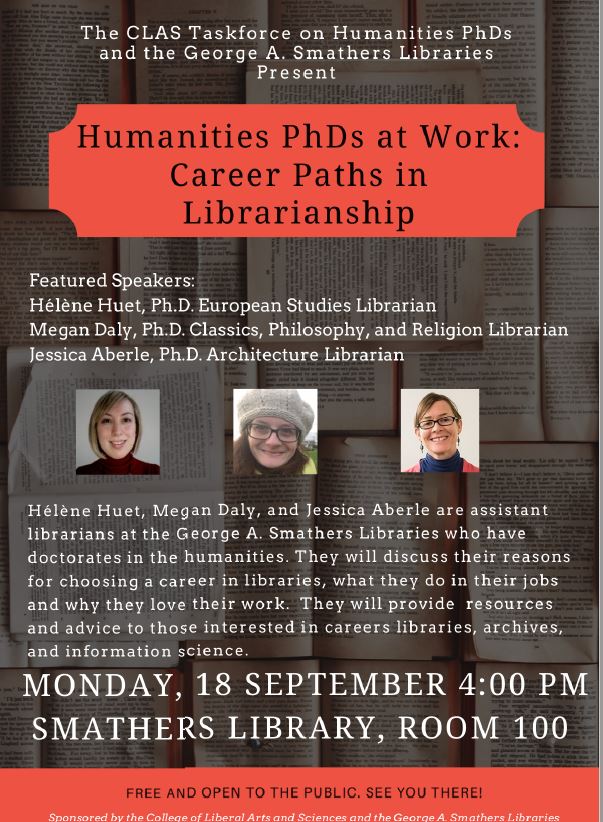
Poster for the “Humanities at Work” Event.
Newsletter for Fall 2017
Hello everyone,
My newsletter for Fall 2017 is out. In it you will find the following information: the services I provide, new resources at the UF Libraries, more information about UF’s institutional repository IR@UF as well as about ORCID, a few quick facts and news, and finally a selection of our latest book acquisitions. Bonne lecture.
Revamped LibGuides
After two years, it was finally time for me to revamp my LibGuides. I am also now in charge of German (in addition to French, Italian, Spanish, and Portuguese) and needed to make sure all the links were up-to-date!
Check them out: French and Francophone Studies, Germanic Studies, Italian Studies, Portuguese Studies, and Spanish Studies.
Workshop Announcement: Information Analysis: The Role of Visualization Tools and Cloud Computing Platforms in Collaborative Research and Teaching
It is my pleasure to announce the following FLDH sponsored workshop that will take place just before HASTAC 2017.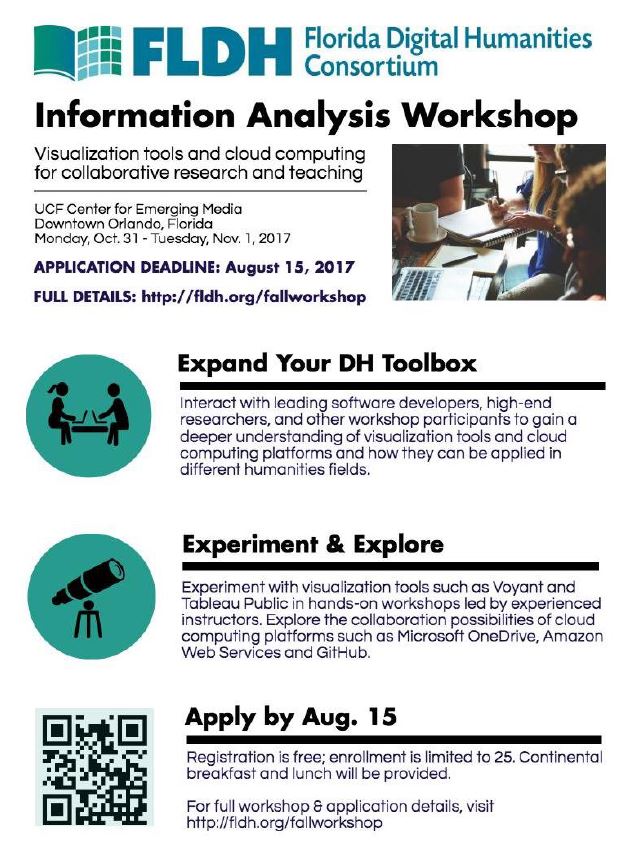 .
.
See here the full workshop announcement: http://fldh.org/fallworkshop/
Position Vacancy Announcement: Electronic Resources Librarian
POSITION VACANCY ANNOUNCEMENT
POSITION: Electronic Resources Librarian
RANK: Assistant University Librarian or Associate University Librarian
REPORTS TO: Chair, Acquisitions & Collections Services
SALARY: $48,492 minimum salary at the Assistant University Librarian rank
$56,098 minimum salary at the Associate University Librarian rank
Actual salary will reflect selected professional’s experience and credentials
REQUISITION #: 502805
DEADLINE: August 14, 2017 (applications will be reviewed beginning July 24, 2017)
Please note the specific instructions to submit application materials on our website at http://web.uflib.ufl.edu/pers/careers.htm and in the APPLICATION PROCESS section below. Failure to include all required documents may result in your application being disqualified.
The Acquisitions and Collections Services Department seeks an experienced Electronic Resources (E-Resources) Librarian to serve as Head of the E-Resources Unit. This is a 12-month, tenure-track faculty position that provides leadership in the management of the complete e-resource lifecycle, coordinates the unit’s activities and workflows, manages the work of, and supervises five full-time staff, and sets goals and objectives for the Unit. The E-Resources Unit is responsible for the acquisition and management of the Libraries’ e-resources and engages in a variety of activities, including licensing and acquiring electronic resources, processing over $8 million dollars in annual e-resource expenditures, managing access via e-resource access and discovery systems, liaising with subject librarians on all e-resource related matters, loading e-resource MAchine Readable Catalog (MARC) records, and creating reports and statistical analysis for collection assessment.
In support of the mission and strategic directions of the Smathers Libraries, the incumbent works collaboratively and fosters positive working relationships with colleagues and with publisher and vendor representatives to ensure patron information needs are met while continuing to build collections that satisfy long-term goals. This position may negotiate license agreements and purchasing arrangements and represent the Libraries by serving on consortial committees. As a tenure-accruing faculty member of the Smathers Libraries and University, the E-Resources Librarian will be expected to pursue research, engage in scholarship and creative activities that generate impact nationally and internationally, including publications, presentations, and grants; as well as professional service activities that meet library-wide tenure and promotion criteria for distinction.
The E-Resources Librarian is expected to include individuals of diverse backgrounds, experiences, races, ethnicities, gender identities, sexual orientations, and perspectives in work activities to support all students and faculty and foster excellence in a diverse and global society.
RESPONSIBILITIES
– Supervise unit employees (5 FTE) and manage the activities and workflows of the E-Resources Unit, including planning and goal setting, workflow review for effectiveness and quality assurance, hiring, training, and evaluating professional staff and student workers
– Plan and coordinate e-resource lifecycle management efforts, including license review and record maintenance, invoicing and activation, access and authentication, MARC batch record loading and other metadata activities, discovery system and e-resource management system configuration and maintenance, and analysis and report creation for collection assessment purposes.
– Maintain effective communication channels and excellent working relationship with subject specialist librarians, library administrators, and publisher/vendor representatives to ensure collection goals are met, including timely renewal and processing of subscriptions and invoices; investigation, planning, and negotiation of new and existing services, purchases, and license terms; and analysis and assessment of e-resource collections and cost effectiveness.
– Continuously improve user interaction with library created and third-party systems, including reviewing settings, investigating and troubleshooting complex access/authentication issues, and advocating for users’ needs by providing constructive feedback on product and platform design and delivery to vendors and publishers.
– Monitor and evaluate publisher and vendor products, services, and costs; provide input to the administrators responsible for collection budget management and library systems selection.
– Contribute as part of the Acquisitions and Collections Services Department leadership team to development of department goals, policies, procedures, priorities, and staffing decisions.
– Maintain active involvement in appropriate professional and subject related national, regional, and state organizations, particularly taking a prominent role in representing the Smathers Libraries with regional and state library consortia e-resource and acquisitions-related committees and group initiatives.
-Engage in professional activities, scholarly research, and service opportunities at the institutional and professional levels as related to assignment and in accordance with the Libraries’ tenure and promotion criteria.
QUALIFICATIONS
Required:
– Master’s degree in Library and/or Information Science from an ALA-accredited program, or equivalent professional experience, plus an advanced degree
– Appointment at the Assistant University Librarian rank requires two years of relevant experience; appointment at the Associate University Librarian rank requires eight years of relevant experience.
– Experience supervising, managing, training and motivating team members
– Experience with integrated library systems (ILSs) and e-resource management, access, and discovery systems
– Experience creating documentation and reports and generating statistics to assess collections and/or acquisition plans
– Demonstrated ability to work collaboratively as a team member to accomplish common goals and adapt to rapidly shifting priorities, goals, and deadlines in a complex, evolving, and diverse environment
– Evidence of excellent interpersonal skills, including verbal and written communication
– Evidence of excellent analytical, organizational, and problem solving skills
– Evidence of working independently and meeting project deadlines
– Evidence of a strong commitment to customer service
-Knowledge of trends in scholarly communication and academic libraries, specifically as related to e-resource management; acquisitions; collections; cataloging and metadata; and/or scholarly communications.
– Record of including individuals of diverse backgrounds, experiences, races, ethnicities, gender identities, sexual orientation, and perspectives in research, teaching, service and other work.
– Strong potential to meet requirements for tenure and promotion (outlined at http://cms.uflib.ufl.edu/Portals/cdh/docs/CDH_Master_Document_v_March_2017_alternate_criteria.pdf).
Preferred:
– Experience reviewing and negotiating license agreements, purchasing terms, and/or vendor services for electronic resources in an academic library
– Understanding of business and licensing models and their budget implications, and the ability to clearly communicate that understanding
– Experience planning and monitoring library collection funds
– Functional experience with Sierra ILS and EBSCO Discovery Service
– Project management experience
– Strong presentation skills
– Experience with Demand/Patron Driven Acquisitions (DDA/PDA), Evidence Based Acquisition Selection (EBA/EBS), or other “just in time” acquisitions models
– Basic understanding of cataloging principles and experience manipulating and batch loading MARC record files
– Involvement in professional development activities, including research and participation in professional organizations.
THE UNIVERSITY OF FLORIDA
The University of Florida (UF) is a major, public, comprehensive, land-grant, research university. The state’s oldest and most comprehensive university, UF is among the nation’s most academically diverse public universities. UF was ranked 9th among public universities in Forbes’ “America’s Best Employers 2015.” UF has a long history of established programs in international education, research and service. In 2013 the Florida Legislature designated UF as the state’s preeminent institution which grew into an opportunity to achieve national and international recognition for the University’s work in serving students and the world. It is one of only 17 public, land-grant universities that belong to the Association of American Universities. UF traces its beginnings to a small seminary in 1853 and is now one of the largest universities in the nation, with more than 50,000 students. For more information, please consult the UF homepage at http://www.ufl.edu.
UNIVERSITY OF FLORIDA LIBRARIES
The libraries of the University of Florida form the largest information resource system in the state of Florida. The UF Libraries consist of seven libraries on the Gainesville campus and three off-campus facilities; six of the campus libraries, and all of the off-site facilities, are in the system known as the George A. Smathers Libraries at the University of Florida. The remaining library is the Lawton Chiles Legal Information Center. Collectively, the UF Libraries (the Smathers Libraries and the Legal Information Center) hold or provide access to over 5.45 million print volumes, 8,100,000 microfilms, 1.25 million e-books, over 152,000 full-text electronic journals, over 1100 electronic databases, 1.26 million documents and 1.35 million maps and images.
The UF Libraries have built several nationally significant research collections, including the Latin American and Caribbean, Judaica, Florida History, Children’s Literature, and Map and Imagery collections. The UF Libraries are a member of the Association of Research Libraries (ARL), the Center for Research Libraries (CRL), and the Association of Southeastern Research Libraries (ASERL). The library staff consists of more than 300 FTE librarians, technical/clerical staff and student assistants. The organizational chart is available at http://www.uflib.ufl.edu/orgchart.pdf.
ACQUISITIONS AND COLLECTIONS SERVICES
The primary mission of the Acquisitions and Collections Services Department is to efficiently acquire resources and materials in a wide range of formats to meet the Strategic Directions and mission of the Smathers Libraries in supporting the academic and professional programs of the University of Florida. The department is divided into three units (Print & Media; Accounting & Serials; and Electronic Resources) and one program (Gifts & Exchange). Each area of operation is expertly staffed and dedicated to a specific set of responsibilities. The units function as a team to perform workflow and implement a variety of initiatives. Most notable daily responsibilities of the Acquisitions and Collections Services Department include allocating, encumbering, and expending a twelve million dollar materials budget; implementing and tracking vendors, invoices, order records, and payments; managing license agreements for e-journals, databases, and a multitude of resources; project management including projects that traverse other departments; handling subscriptions for thousands of print/online serials and standing orders; overseeing several large approval/slip plans and firm ordering for print and e-books from booksellers and publishers across the world; and being the principal department for batch-loading thousands of vendor, publisher and OCLC bibliographic records into the library catalog.
COMMUNITY
Gainesville, Florida and the surrounding community are home to approximately 257,000 people and both the University of Florida and Santa Fe College. Situated just over an hour from the Gulf of Mexico and the Atlantic Ocean, the city is surrounded by over 40 nature parks, including many spring-fed lakes and rivers. In 2015, Gainesville was named the “Best Midsize College City in America” by WalletHub and ranked no. 7 on Livability.com “Top 10 College Towns”. Gainesville is known as an innovative municipal government and an innovative city. Gainesville continues to receive national recognition as a top-rated city. Some of Gainesville’s accolades are listed at the Gainesville Awards and Recognition link. The Guide to Greater Gainesville combines award winning photography and compelling articles that capture all the reasons for calling Greater Gainesville your next home. The area has numerous cultural institutions and is a haven for sports fans. Jacksonville, Orlando, Tampa, Tallahassee, and St. Augustine are all within a two-hour drive. Gainesville is an affordable city and area to live in – using a cost of living calculator you can compare cities across the United States. See how affordable Gainesville really is!
BENEFITS
Vacation days, paid holidays, and sick leave days; retirement plan options; insurance benefits; tuition fee waiver program; no state or local income tax. Prospective employees should review the information about employment and benefits at UF available at http://hr.ufl.edu/benefits/.
APPLICATION PROCESS
To apply, submit 1) a cover letter detailing your interest in and qualifications for this position; 2) a written statement on how changes in the e-resources landscape are affecting users and collections at large research institutions (250 words); 3) your current resume or CV; and 4) a list of three references including their contact information (address, telephone number, and email). Apply by August 14, 2017 (applications will be reviewed beginning July 24, 2017). Submit all application materials through the Jobs at UF online application system at http://explore.jobs.ufl.edu/cw/en-us/job/502805/electronic-resources-librarian. Failure to include all required documents may result in your application being disqualified. If you have questions or concerns about the process please contact Bonnie Smith, George A. Smathers Libraries Human Resources Office, at bonniesmith@ufl.edu.
The University of Florida is an Affirmative Action, Equal Opportunity Employer and encourages applications from women and minority group members. We are dedicated to the goal of building a culturally diverse and pluralistic environment; we strongly encourage applications from women, members of underrepresented groups, individuals with disabilities, and veterans. As part of the application process, applicants are invited to complete an on-line confidential and voluntary demographic self-disclosure form which can be found at: http://www.hr.ufl.edu/job/datacard.htm. This information is collected by the University of Florida’s Office of Human Resources to track applicant trends and is in no way considered by the Smathers Libraries in the selection process.
Final candidate will be required to provide official transcript to the hiring department upon hire. A transcript will not be considered “official” if a designation of “Issued to Student” is visible. Degrees earned from an education institution outside of the United States are required to be evaluated by a professional credentialing service provider approved by National Association of Credential Evaluation Services (NACES), which can be found at http://www.naces.org/.
Symposium, Collaborating Across the Divide: Digital Humanities and the Caribbean, Sept. 21-22, 2017 University of Florida
Please save the date for the upcoming symposium:
Collaborating Across the Divide: Digital Humanities and the Caribbean
Date: September 21 and 22
Locations: Smathers Library, room 100
The full event information is online (http://digitalhumanities.group.ufl.edu/event/collaborating-across-the-divide-digital-humanities-and-globalization-sept-21-23-2017/).
We hope that you can join for the symposium, and we look forward to the event as a place for conversation on next steps in regional collaboration! Please share on any questions, and please share this with others!
================
About the Symposium:
Digital technology has made the early twenty-first century a critical moment of opportunity by providing access to a wide range of library and archival materials and by offering new means of teaching, analyzing content, and presenting literary scholarship. While digital technologies have the promise of bridging institutional and geographic barriers, they have also continued to reproduce colonial hierarchies and marginalize content from the Caribbean and the Global South. This symposium, “Collaborating Across the Divide: Digital Humanities and the Caribbean,” brings together scholars and artists from the Caribbean and the United States to discuss how to collaborate through digital humanities in ways that decolonize knowledge and empower Caribbean subjects, rather than reaffirm colonial histories of archiving and education. The project will center on the Digital Library of the Caribbean (www.dloc.com), an international partnership whose technological and DH hub is the University of Florida. The objective of the symposium is to produce an action plan for making dLOC a hub for pedagogical, scholarly, and artistic collaboration.
Schedule:
Thursday, 21 Sept., 5-6:45pm:
- Introduction and Presentation: Oonya Kempadoo
Friday, 22 Sept.:
- 9-10:45am: Panel: “DH and Non-DH Collaboration within the Academy,” Rosamond King and Matthew Smith
- 10:45-11am: Break
- 11am-12:45pm: Panel: “Public Humanities and DH Collaboration: Pedagogy beyond Academia,” Gabriele Hosein and Schuyler Esprit
- 12:45-2:15pm: Lunch Break
- 2:15-3:15pm: Platforms for Caribbean DH: Thomas Hale and others
- 3:15-3:30pm: Break
- 3:30-5pm, Roundtable:
- 5-5:15pm: Closing remarks
Speakers:
OONYA KEMPADOO is author of Buxton Spice (1997), winner of the Tide Running (2001), and All Decent Animals (2013); winner of the Casa de Las Americas Prize (2002), and consultant in the arts and social development, including work with UNICEF, UNAID. She was Fulbright Scholar-in-Residence and Creative Writing Instructor (2013-2014) at two colleges in Connecticut; and serves advisor to Caribbean literacy non-profit “Hands Across the Sea” and co-founder of the Grenada Community Library & Resource Center in St George’s Grenada. An internationally acclaimed novelist, she is a leader in digital arts and educational collaboration in the Caribbean. Kempadoo has initiated two digital projects to support environmental sustainability in the Caribbean. The first, Naniki, is a speculative fiction, multi-media, eco-social project designed to engage students in the Caribbean and other countries in using digital technology and supporting environmental sustainability. The second, Carisealand, is a digital platform for scholars, artists, and the public for sharing projects on sustainability, designed and built by Create Caribbean Research Institute and it’s students (Dominica State College).
SCHUYLER ESPRIT is a scholar of Caribbean literature and cultural studies. Dr. Esprit holds a PhD in English literature from University of Maryland – College Park. She currently serves as dean of Academic Affairs at Dominica State College as well as director of the Create Caribbean Research Institute. She has pioneered Digital Humanities projects and digital technology training at the K-12 and College level in Dominica as well as collaboratively, linking classes at the Dominica State College and classes at colleges in the United States. She is now completing her book manuscript and its digital companion, both entitled Occasions for Caribbean Reading, a historical exploration of reading culture in the Caribbean.
GABRIELLE HOSEIN, Director of the Institute for Gender & Development Studies, at the University of the West Indies, St. Augustine (Trinidad), which is home to several significant digital and public humanities projects, including Caribbean Review of Gender Studies, an open access peer-reviewed journal, of which Hosein is associate editor. Hosein is Principle Investigator for Politics, Power and Gender Justice in the Anglophone Caribbean, 2011-2014, member of the research team for the project Building Responsive Policy: Gender, Sexual Cultures and HIV & AIDS in the Caribbean, 2008-2011, and co-editor of Indo-Caribbean Feminist Thought Genealogies, Theories, Enactments (Palgrave 2016).
MATTHEW J. SMITH is Professor in History and Head, Department of History and Archaeology, The UWI, Mona. His areas of research include Haitian politics, society, and migration. He is the author of the books Liberty, Fraternity, Exile: Haiti and Jamaica After Emancipation (University of North Carolina Press, 2014), winner of the Haiti Illumination Project Book Prize from the Haitian Studies Association and Red and Black in Haiti: Radicalism, Conflict, and Political Change, 1934-1957 (University of North Carolina Press, 2009) which was a winner of the Gordon K and Sybil Lewis prize for best book in Caribbean History from the Caribbean Studies Association. He had contributed significantly to dLOC’s teacher training program and to its edited collection Haiti: An Island Luminous; his service work utilizes the digital for critical needs, including as Director of UWI-Mona’s Haiti Initiative following the 2010 earthquake providing assistance to Haitian university students and the Haitian national library, his work serving as Director of the UWI’s Social History Project, and as member of the Board of Museums and Archives of the Institute of Jamaica.
ROSAMOND KING (Associate Professor of English, Brooklyn College, CUNY) is a critical and creative writer and artist, whose work focuses on the Caribbean and sexuality. Her book Island Bodies: Transgressive Sexualities in the Caribbean Imagination won the 2015 Caribbean Studies Association Gordon K. and Sybil Lewis Prize for the best Caribbean Studies Book. She is also a poet, artist, and performer with an extensive record of publications and performances. She is also a leader in digitizing LBGTQ archival materials from the Caribbean for dLOC and has collaboratively developed and taught with Dr. Angelique Nixon, a distributed online collaborative course (DOCC) in the US and Caribbean on sexualities.
THOMAS HALE was one of the founders of the African Literature Association, a field of study that developed in the early 1970s. Two of his early books reflect this initiative: The Teaching of African Literature and Artist and Audience: African Literature as a Shared Experience. He devoted several decades to research and publication on the oral traditions in West Africa, where he recorded epics narrated by griots, professional bards who maintain the cultural heritage of peoples in the Sahel region. He is also a prominent scholar on Aimé Césaire and has recently developed an online annotated bibliography of Césaire: http://lesecritscesaire.libraries.psu.edu/. He served as head of the Department of French and Francophone Studies at the Pennsylvania State University from 2001 to 2008.
- For additional information, please contact Laurie Taylor (laurien@ufl.edu).
- All events in the Smathers Library, room 100.
- All events are free and open to the public.
- Sponsored by the Center for the Humanities and the Public Sphere with support from the Rothman Endowment.
- Co-Sponsored by the Creative Campus Program, Center for Latin American Studies, the Interdisciplinary Working Group on Caribbean Arts and Humanities, the Science Fiction Working Group, and Imagining Climate Change, the George A. Smathers Libraries, the Center for Gender, Sexualities, and Women’s Studies Research, the Department of English, the Department of History, and the UF Informatics Institute.
- Program Team Members: Leah Rosenberg, Randi Gill-Sadler, Prea Persaud; Chelsea Dinsmore, Tace Hedrick, Emily Hind, Maria Rogal, Malini Johar Schueller, Maya Stanfield-Mazzi, Dhanashree Thorat, Laurie Taylor
New dLOC Video Tutorials in Spanish
Hello everyone,
A few weeks ago I was awarded a Smathers graduate student internship, which enabled me to hire a graduate student to support dLOC‘s ongoing efforts to enhance its website’s accessibility and ease of navigation for Spanish users.
Today we release the first task the intern had to do: create video tutorials in Spanish with captions on the following topics: What is dLOC? How does one do a simple search? How does one do a text search? How does one do an advanced search? How does one do a map search? And last but not least, How does one read an item and its metadata?
Thank you so much to my intern, Francesc Morales for his hard work on these.
PS: If for some reason you want to read my proposal for the internship, then please go ahead and have fun.
New Vacancy: Metadata Librarian
POSITION: Metadata Librarian
RANK: Assistant University Librarian or Associate University Librarian
REPORTS TO: Chair, Digital Production Services
SALARY: Actual salary will reflect selected professional’s experience and credentials
Minimum Salary at the Assistant Librarian rank is $48,492
Minimum Salary at the Associate Librarian rank is $56,098
REQUISITION #: 502568
DEADLINE DATE: July 17, 2017. Review of applications will begin June 15, 2017
NOTE: Office located off campus
Please note that this posting has specific instructions for the submission of application materials – see our website at: http://web.uflib.ufl.edu/pers/careers.htm or the APPLICATION PROCESS section below for further details. Failure to submit the required documents may result in the application not being considered.
JOB SUMMARY
The University of Florida, George A. Smathers Libraries seek a Metadata Librarian for a 12-month tenure track Library faculty position in the Digital Production Services Department. The Department is a user focused, data enhancing, hands-on, collegial team that strives for efficiencies and streamlined procedures to maximize findability.
The Metadata Librarian creates and revises descriptive, administrative, and technical metadata to facilitate access, discovery, and support of digitized collections. The Metadata Librarian works closely with the Cataloging Services Department and various stakeholders across multiple units; plays a key role in large-scale projects, such as testing machine assisted indexing as a means of retrospectively enhancing metadata in the University of Florida Digital Collections (UFDC); and collaborates on ontology and metadata schema development as well as on metadata and information organization needs. The Metadata Librarian contributes to local policy and procedure decisions, develops and assesses workflows, and seeks creative approaches for managing metadata.
The Metadata Librarian pursues professional development opportunities and engages in research, publication, and professional association activities to meet library-wide criteria for tenure and promotion. The Libraries encourage broad participation in reaching management decisions and consequently the Metadata Librarian serves on various committees and teams.
RESPONSIBILITIES
– Manipulates, transforms, and creates metadata in UFDC and in the Libraries’ Integrated Library System (ILS). Responsible for clean-up projects, utilizing batch loading and editing tools in pursuit of workflow efficiencies, to improve access, actionability, and processing of library resources.
– Participates in planning and executing data migrations between information systems.
– Applies expertise in manipulation and transformation of metadata to assist with designing and updating workflows.
– Designs and implements metadata, crosswalks, standards/policies, workflows, and tools to support access to collections of digitized and born-digital materials in multiple digital collection management systems and to support long-term preservation of those materials deposited into the UFDC.
– Serves as a resource for colleagues in all campus libraries, advising on appropriate strategies as well as assisting with creating and repairing metadata.
– Develops and delivers training on non-MARC metadata skills to broaden the pool of Library employees who can contribute to digital collection metadata work.
– Maintains awareness of developments and best practices in non-MARC metadata for institutional repositories and digital collections, as well as bibliographic description (i.e. BIBFRAME, linked data), and is involved in strategic planning to prepare the Smathers Libraries for advancing in these areas.
– Strengthens and creates avenues for collaboration across the Libraries to improve access to collections through various metadata systems and ontologies.
– Serves as a representative on various library committees, particularly for providing expertise in the area of metadata and authority control, and serving on other committees and groups as appropriate.
– Follows and participates in local, regional, and national discussions on metadata workflows, batch processes, and integrated processes across standards and types.
– Directs the work of project teams.
– Includes and supports individuals of diverse backgrounds, experiences, races, ethnicities, genders, gender identities, and perspectives in work activities, to support all students and faculty and foster excellence in a diverse and global society.
– Performs scholarly research and provides service at institutional and professional levels as related to assignment and in accordance with the Libraries’ tenure and promotion criteria (see: http://web.uflib.ufl.edu/pers/cdh/)
QUALIFICATIONS
Required:
– ALA-accredited master’s degree in library science or other relevant advanced degree.
– Eight years of relevant, post graduate degree, professional experience for appointment at the Associate University Librarian rank.
– Demonstrated experience using various metadata schemas, vocabularies, and content standards (such as DC, EAD, AACR2, RDA, LCSH, PREMIS, MODS, METS) and various encoding/transmission formats (such as RDF, XML, MARC, JSON)
– Excellent interpersonal skills.
– Demonstrated experience with any of the following tools (or others like them) to create, extract, transform, analyze, and/or quality control metadata: XSLT, Microsoft Excel, MarcEdit, OpenRefine, scripting languages, regular expressions, SQL.
– Demonstrated experience in successful project management.
– Familiarity with the linked data environment, including emerging library applications (e.g., BIBFRAME) and name identifier systems (e.g., ORCID, ISNI).
– Evidence of positive and productive collaborations working with diverse audiences, constituencies, and colleagues.
– Initiative, flexibility and the ability to adapt to a complex, rapidly changing academic environment
– Superior verbal and written communication skills with the ability to explain complex issues in concise terms to a broad range of constituents.
– Ability to work both independently and collaboratively with faculty, students, administrators, and the general public.
– Record of including individuals of diverse backgrounds, experiences, races, ethnicities, gender identities, sexual orientation, and perspectives in research, teaching, service and other work.
– Strong potential for meeting the requirements of tenure and promotion outlined at http://library.ufl.edu/cdh.
Preferred:
– Two years of relevant, post graduate degree, professional experience for appointment at the Assistant University Librarian rank.
– Experience building ontologies and knowledge of standards and languages for ontology-building in a Linked Data environment (such as RDFS, OWL, and SKOS).
– Experience with metadata creation in an academic or research library.
– Knowledge of the principles of information organization as required in building and applying ontologies (including taxonomies, classification schemes, thesauri, and metadata element sets).
– Supervisory experience.
– Demonstrated ability to improve workflows or data maintenance tasks using automated processes.
– Reading fluency in French or Spanish.
– Metadata experience with special collections material.
– Experience contributing bibliographic and authority records using national Program for Cooperative Cataloging standards or other national or international programs for descriptive, structural, and administrative metadata.
THE UNIVERSITY OF FLORIDA
The University of Florida (UF) is a major, public, comprehensive, land-grant, research university. The state’s oldest and most comprehensive university, UF is among the nation’s most academically diverse public universities. UF has a long history of established programs in international education, research and service. In 2013 the Florida Legislature designated UF as the state’s preeminent institution which grew into an opportunity to achieve national and international recognition for the University’s work in serving students and the world. It is one of only 17 public, land-grant universities that belong to the Association of American Universities. UF traces its beginnings to a small seminary in 1853 and is now one of the largest universities in the nation, with more than 50,000 students. For more information, please consult the UF homepage at http://www.ufl.edu.
GEORGE A. SMATHERS LIBRARIES
The libraries of the University of Florida form the largest information resource system in the state of Florida. The UF Libraries consist of seven libraries on the Gainesville campus and three off-campus facilities; six of the campus libraries, and all of the off-site facilities, are in the system known as the George A. Smathers Libraries at the University of Florida. The remaining library is the Lawton Chiles Legal Information Center. Collectively, the UF Libraries (the Smathers Libraries and the Legal Information Center) hold or provide access to over 5.45 million print volumes, 8,100,000 microfilms, 1.25 million e-books, over 152,000 full-text electronic journals, over 1100 electronic databases, 1.26 million documents and 1.35 million maps and images.
The UF Libraries have built a number of nationally significant research collections, including the Latin American, Judaica, Florida History, Children’s Literature, and Maps and Imagery collections. The UF Libraries are a member of the Association of Research Libraries (ARL), the Center for Research Libraries (CRL), and the Association of Southeastern Research Libraries (ASERL). The library staff consists of more than 300 FTE librarians, technical/clerical staff and student assistants. The organizational chart is available at http://www.uflib.ufl.edu/orgchart.pdf.
DIGITAL PRODUCTION SERVICES
Digital Production Services develops, manages, and publishes digital content from curatorial collections, in support of academic programs, organizes conversion and ingest capabilities, facilitates awareness and coordinates instruction in scholarly use and development of digital technologies and their application to collection and publishing services. The department manages the University of Florida Digital Collections (UFDC) and the Digital Library of the Caribbean (dLOC) and facilitates the flow of digital collection material to other digital repositories (HathiTrust, DPLA, PALMM) and ensures that materials are properly archived to digital preservation systems.
COMMUNITY
Gainesville, Florida and the surrounding community are home to approximately 257,000 people and both the University of Florida and Santa Fe College. Situated just over an hour from the Gulf of Mexico and the Atlantic Ocean, the city is surrounded by over 40 nature parks, including many spring-fed lakes and rivers. In 2015, Gainesville was named the “Best Midsize College City in America” by WalletHub and ranked no. 7 on Livability.com “Top 10 College Towns”. Gainesville is known as an innovative municipal government and an innovative city. Gainesville continues to receive national recognition as a top-rated city. Some of Gainesville’s accolades are listed at the Gainesville Awards and Recognition link. The Guide to Greater Gainesville combines award winning photography and compelling articles that capture all of the reasons for calling Greater Gainesville your next home. The area has numerous cultural institutions and is a haven for sports fans. Jacksonville, Orlando, Tampa, Tallahassee, and St. Augustine are all within a two-hour drive.
BENEFITS
Vacation days, paid holidays, and sick leave days; retirement plan options; insurance benefits; tuition fee waiver program; no state or local income tax. Prospective employees should review the information about employment and benefits at UF available at http://hr.ufl.edu/benefits/.
APPLICATION PROCESS
To apply, submit 1) a cover letter detailing your interest in and qualifications for this position; 2) a written statement regarding current trends related to digitization, metadata creation, and digital preservation (250 words); 3) your current resume or CV; and 4) a list of three references including their contact information (address, telephone number, and email). Apply by July 17, 2017 (applications will be reviewed beginning June 15, 2017). Submit all application materials through the Jobs at UF online application system at http://explore.jobs.ufl.edu/cw/en-us/job/502568/metadata-librarian. Failure to submit the required documents may result in the application not being considered. If you have any questions or concerns about this process please contact Bonnie Smith, George A. Smathers Libraries Human Resources Office, at bonniesmith@ufl.edu.
The University of Florida is an Affirmative Action, Equal Opportunity Employer and encourages applications from women and minority group members. We are dedicated to the goal of building a culturally diverse and pluralistic environment; we strongly encourage applications from women, members of underrepresented groups, individuals with disabilities, and veterans. As part of the application process, applicants are invited to complete an on-line confidential and voluntary demographic self-disclosure form which can be found at: http://www.hr.ufl.edu/job/datacard.htm. This information is collected by the University of Florida’s Office of Human Resources to track applicant trends and is in no way considered by the Smathers Libraries in the selection process.
Final candidate will be required to provide official transcript to the hiring department upon hire. A transcript will not be considered “official” if a designation of “Issued to Student” is visible. Degrees earned from an education institution outside of the United States are required to be evaluated by a professional credentialing service provider approved by National Association of Credential Evaluation Services (NACES), which can be found at http://www.naces.org/.