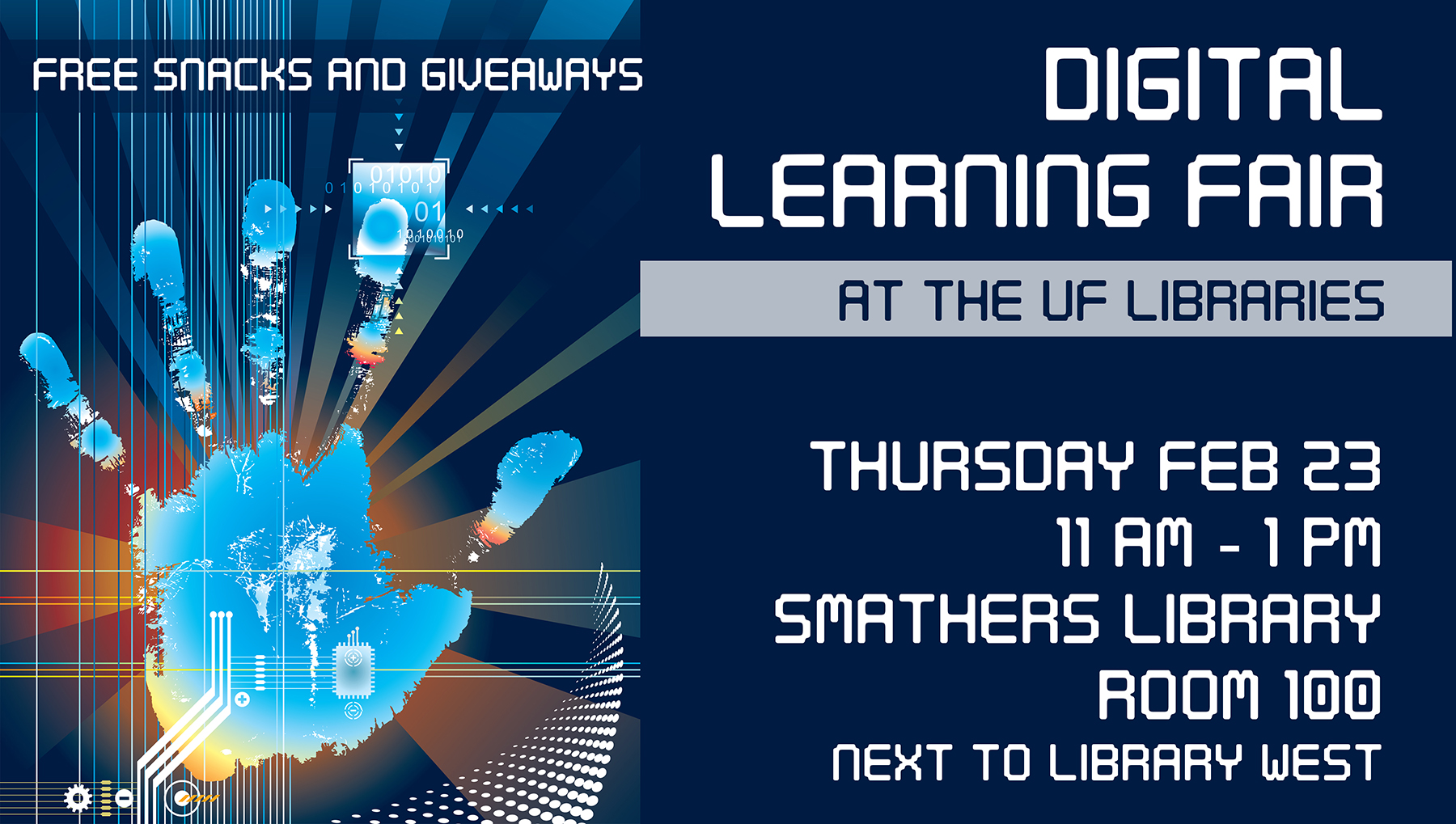
Do you want to ace your paper? Impress your friends? Improve your chances of finding a job? Join us for UF Libraries’ Digital Learning Fair on February 23!
The Fair brings librarians and students together to highlight steps for finding the best research online and organizing your work quickly, plus the One Button Studio, 3-D printing, video streaming access, digital newspapers, maps and mapping tools, institutional repository and digital archival collections . . .
AND FREE SNACKS & GIVEAWAYS!
Don’t miss out. Meet us in Smathers East, Room 100–right next to Library West (look for balloons), and use #GatorsGoDigital to share what you learn.
Hosted in connection with Digital Learning Day.
Category Archives: Academia
HASTAC 2017: The Possible Worlds of Digital Humanities
As a member of the program committee, I am very pleased to share with you the Call for Papers for next HASTAC Conference: The Possible Worlds of Digital Humanities, taking place in Orlando, Nov.2-4, 2017.
The lead sponsor and organizing group is the Florida Digital Humanities Consortium (FLDH) and the deadline for your proposals is April 7.
HASTAC 2017: The Possible Worlds of Digital Humanities
November 2-4, 2017
University of Central Florida, Orlando, Florida
hastac2017.org
#HASTAC17
Call For Proposals
Submissions Deadline: April 7, 2017
In 2017, we invite you to join us at the University of Central Florida to explore “The Possible Worlds of Digital Humanities.” Orlando is known to tourists worldwide for theme parks that bring to life many imagined worlds and narratives, most of which reflect back to us dominant discourses and ideologies. Likewise, digital humanities struggles with building towards a future that is more inclusive and interdisciplinary. This year, we hope to address the unsolved hard problems and explore the new opportunities of the digital humanities. We particularly welcome submissions addressing themes such as:
- challenges of monolingualism within the digital humanities
- indigenous culture, decolonial and post-colonial theory and technology
- technology and education–open learning, peer learning, and issues of access, equity for primary and/or higher education
- communication of knowledge, publishing, and intellectual property
- digital cultural heritage and hegemony
- interdisciplinary goals and conversations in digital humanities
- digital humanities and gender, race, and other identities
- simulation, modeling, and visualization
- games and gaming, including for learning
- community development including the importance of art and culture districts
- other unsolved hard problems in digital humanities
HASTAC 2017 will include plenary panels, workshops, roundtables, short “soapbox” talks, project demos, poster sessions, and a curated media arts show exhibition. At HASTAC, we invite you to think about the format of your session as well as the content.
We seek proposals for participant presentations in the following categories:
- 5-8 minute “soapbox” talks
- roundtables (be creative with your format — no reading papers!)
- project demos
- digital and/or print posters
- maker sessions or workshops
- Media arts (new media, games, and electronic literature)
For each submission, we will need the following information from you:
1) complete contact information including valid phone, email, and institutional affiliation, if any;
2) maximum 500-word abstract of the work you would like to present that must discuss its relationship to the conference themes;
3) any technical requirements or other support (including space requirements) that may be required for the presentation. For exhibitions or other performances, please indicate any equipment that is absolutely required and that you cannot bring with you. In the event that we cannot guarantee access to the equipment, we regret that we may not be able to accept your proposal.
Digital and/or Print Posters Wanted!
Print posters (4 x 3’) and electronic posters (to be projected) are solicited for emerging projects, ideas, and scholars. In presenting your research with a poster, you should aim to use the poster as a means for generating active discussion of your research. Limit the text to about one-fourth of the poster space, and use visuals (graphs, photographs, schematics, maps, etc.) to tell your story. Use the regular submission form, but indicate that you are proposing a Poster by checking the appropriate box.
Maker Sessions & Workshops
We will provide some room and resources for individuals or groups to create informal maker spaces, where conference participants can share, exchange, and experiment with new online tools, personal fabrication technologies, open source electronics such as Arduino, and other creative and learning devices and gadgets. To propose a maker session or workshop, please use the standard submission form and indicate that yours is a maker session. Please also tell us how long the session requires!
Media Arts Show
The Media Arts Show invites creative works that engage with the show’s theme, “Soft(ware) Solutions / Hard Problems.” Works of new media, including games, electronic literature, and installations that meld physical and digital components, are welcome. Please provide a detailed description of the work, its purpose, and all technical and physical requirements for display.
All proposals will be peer-reviewed, but we regret that we cannot provide detailed reviewer feedback. We welcome applications from scholars at all stages of their careers from all disciplines and fields, from private sector companies and public sector organizations, from artists and public intellectuals, and from networks and individuals.
Submit your proposal
Graduate Student Research Series Spring 17
And we are back for another semester of workshops dedicated to helping graduate students with their research. Two colleagues and I will be offering 4 workshops on the following topics: Finding scholarly sources, Reading scholarly sources effectively, Building scholarly knowledge in your field, and Tips for writing an effective scholarly paper.
The sessions are open to all graduate and professional students at UF and will be held in room 212 Library West (aka Scott Nygren Studio) from 1.55-2.45pm.
See you there.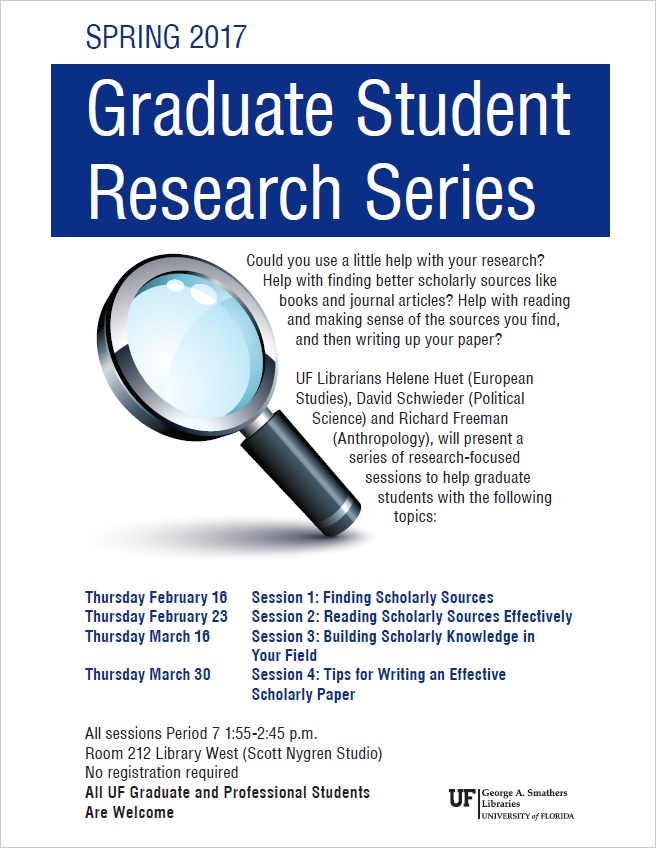
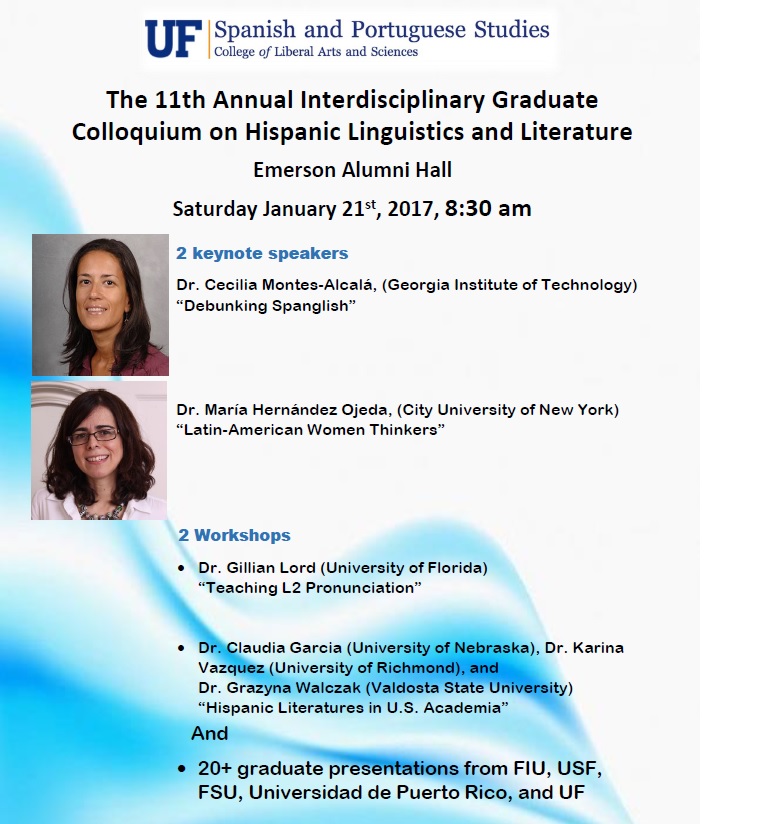
The 11th Annual Interdisciplinary Graduate Colloquium on Hispanic Linguistics and Literature
On Saturday January 21, 2017, the 11th Annual Interdisciplinary Graduate Colloquium on Hispanic Linguistics and Literature will take place in Emerson Alumni Hall, starting at 8.30 am. It is free and open to the public.
Issues in Humanities Data Sharing
I would like to share with you the gist of the presentation I gave to the National Federation of Advanced Information Services 2016 Humanities Roundtable in Atlanta in September 2016.
For this talk, I focused on one of the biggest barriers to humanities data sharing: fear. Fear can take many forms, but the one I wanted to discuss was the fear of not getting credit.
This fear of not getting credit is what framed my talk. First, I explained how this fear has impacted, and in some cases inhibited, my work as a digital humanist. Second, I discussed how I have tried to overcome this fear. Third and finally, I discussed how, as a liaison librarian, I am trying to help faculty and graduate students overcome their own fears of not getting credit for their work.
Fear as a Digital Humanist
First, it is important for me to point out that the fear of not getting credit has prevented me from sharing more information as part of my digital humanities project, Mapping Decadence. Where did this fear originate and why did I become afraid of putting too much information on my website?
The fear was instilled in me at the very beginning of graduate school, years before I started developing my project. Some faculty members made it clear that publishing articles was the most important thing I could do to advance my career. While my digital project was interesting and “trendy”—and thus an asset on the job market—what mattered more were the articles I could base on this project. As such, when I started working on my DH mapping project, I was advised not to put too much information online. Doing so, I was warned, might enable other scholars to steal my work (and thus prevent me from getting my articles in print).
Retrospectively, I should have realized that making my research available online would only enhance my profile and help me on the job market. And so it did.
Just as importantly, sharing my research allows me to fulfill my original goal for Mapping Decadence. The reason I wanted to create a DH project in the first place was to be able to share my work/data with everyone who has internet access. I don’t believe our research should only be only accessible to a happy few.
What are the steps I have taken to try to overcome my fear of not getting credit? (spoiler alert: I still worry about not getting credit)
- I listened to colleagues and collaborators who told me that my project would be greatly enhanced by sharing more information. These individuals include:
- Kathy Weimer (Head of Kelley Center for Government Information, Data, and Geospatial Services at Rice University) during a GIS workshop for the international DH conference in Sydney, Australia;
- Miriam Posner (DH program coordinator at UCLA)’s students who reviewed my project for a class (I found these reviews by chance when googling my website);
- Paige Morgan, DH librarian at the University of Miami.
- In each case, my reviewers consistently informed me that I needed to share more data.
- Some of the information that I was encouraged to share has or will be easy to add to the project. These modifications include noting the sources of my data and adding legends to my maps.
- Nevertheless, there are others kinds of information my reviewers asked me to share that will pose greater challenges – not least because of my deeply-instilled fears. These include sharing my analyses/results. This kind of modification to the project remains a roadblock, as I am on the TT and I need to publish an analysis of my data in article form for tenure.
Dealing with others’ fears as a liaison librarian
Finally, as a liaison librarian, I have tried to help faculty and graduate students overcome their fear of not getting credit. Let me start by sharing a little anecdote: I met a professor once who explained that s/he only presents papers that have already been accepted for publications because s/he does not want their research stolen. I am sure we all know someone who does this kind of thing. But I have to say, this is so far from the way I see and do things that, as a liaison librarian and a scholar, I have been actively working to help others deal with their fears.
This is why I believe that “education” is the keyword here. The first step I take is talking about the advantages of putting one’s work online (enhancing one’s scholarly profile, earning colleagues’ goodwill, etc.). The second step I take is reminding scholars that there are large and important aspects of their work that they can share without revealing their conclusions or endangering their publications.
What are my strategies to provide education that would help scholars overcome their fears?
- Educate colleagues about the Institutional Repository (IR@UF where I work for instance). Many people believe that, simply because they’ve published an article on a topic, it is now widely available to others. Introducing colleagues to the IR thus helps acquaint them with larger research accessibility issues while directing them to institutional resources that will help put their work before a wider audience.
- Provide education through Digital Humanities working groups: help organize talks and invite speakers who have experience in the digital world, promote the events to my patrons and incite them to attend the talks/workshops, etc.
- Use examples that show colleagues how sharing data can result in positive career outcomes. Rather than seeing data sharing as an invitation to data theft, I want scholars to view data sharing as a way to boost one’s profile, attach one’s name to a project, and advance other scholars’ work in the process. The benefits of sharing thus far outweigh possible risks.
This is not to say these strategies always work. It can be hard to get meetings with faculty to discuss IR/DH/data and it is much easier when this is done on a 1-on-1 basis. But little by little, my hope is that humanities scholars will overcome their fear and see the benefits of data sharing.
Webinar Series: Caribbean Scholarship in the Digital Age
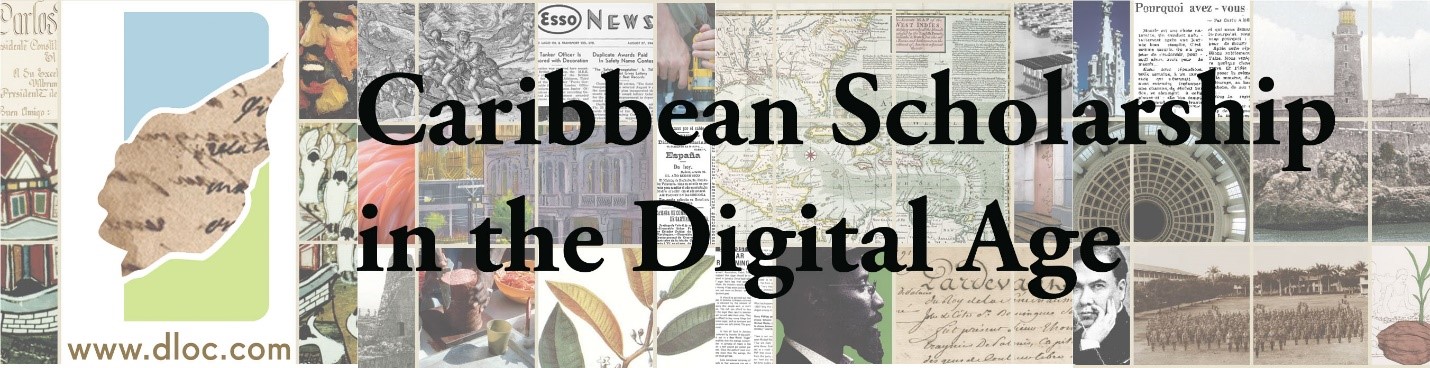
Caribbean Scholarship in the Digital Age is a webinar series showcasing digital and/as public research and teaching in Caribbean Studies. The series provides a collaborative space for professionals to share on projects and experiences to foster communication and support our shared constellations of communities of practice.
Please join us for an upcoming event featuring innovative digital work in Dominica on January 18, 2017, at 11am (Miami Time).
Presenter: Dr. Schuyler Esprit, Dominica State College, Create Caribbean Inc.
Click here to participate in the online event: http://ufsmathers.adobeconnect.com/Caribbean
About the Presentation:
In the small island developing state of the Commonwealth of Dominica, the push towards Information and Communications Technology (ICT) development has risen rapidly on the national agenda. This is true for several sectors, including entrepreneurship and education. However, national efforts to understand the impact of expanding technologies, particularly through the use of digital humanities or humanities computing, has been much slower despite collective enthusiasm among library and museum experts, academics and other intellectuals workers about developing the technological scope and reach of their work. For the most part, efforts and resources to encourage ICT use have minimized these very knowledge and culture nerve centers that inform the content of entrepreneurship through technology. Create Caribbean Inc. is a research institute located in Dominica, designed on the principles and values of digital scholarship and practicing digital humanities methodologies, and is one of the first of its kind in the English-speaking Caribbean to formalize the confluence of archival studies, heritage preservation, academic research, higher education curriculum development and the wave of technological advancement. Founded in 2014, the Institute has entered into a partnership with the Dominica State College to institutionalize and create national conversation and impact on innovative knowledge acquisition and sharing amidst economic and geographic constraints that create large social gaps in access to libraries, research, cultural activities and technological experimentation. This presentation will explore the best practices of Create Caribbean Inc., the Research Institute at Dominica State College to consider its goals and objectives, growth process, challenges and plans for enhancement and expansion beyond Dominica and into the wider Caribbean. The presentation will outline the role of each of the institute’s core areas – heritage preservation, academic research, higher education curriculum development, college teaching and community outreach – through the lens of the digital humanities and its impact on the Caribbean space. I will also include a discussion of the benefits of adopting digital humanities vocabulary, theory and praxis within the region, adapting those elements to considerations of economic, social and political peculiarities of the Caribbean.
About the Speaker: Dr. Schuyler Esprit is a scholar of Caribbean literature and cultural studies, and postcolonial theory. Dr. Esprit holds a PhD in English literature from University of Maryland – College Park. She is the Founding Director of Create Caribbean Inc. (http://createcaribbean.org/create/), Research Institute at Dominica State College. The Research Institute supports students and scholars to use digital technologies for research, teaching and learning in areas of Caribbean development, especially its culture, history and heritage. She currently works as Dean of Academic Affairs at Dominica State College. Dr. Esprit has also taught and held professional positions at a number of universities in the United States. She is now completing her book entitled West Indian Readers: A Social History and its digital companion, both of which are historical explorations of reading culture in the Caribbean. She has also written the introduction to the 2016 Papillote Press edition of The Orchid House, the 1953 novel by Dominican writer Phyllis Shand Allfrey.
About the Caribbean Scholarship in the Digital Age Webinar Series:
The Digital Library of the Caribbean (dLOC), in partnership with the Association of Caribbean University, Research and Institutional Libraries (ACURIL), the Graduate School of Information Sciences and Technologies of the University of Puerto Rico, and the Latin American and Caribbean Cultural Heritage Archives roundtable (LACCHA) of the Society of American Archivists (SAA), has organized a series of online events, Caribbean Scholarship in the Digital Age, a webinar series showcasing digital and/as public research and teaching in Caribbean Studies. The series provides a collaborative space for professionals to share on projects and experiences to foster communication and support our shared constellations of communities of practice.
Other upcoming webinars in the series include:
- Feb. 28, 11am Miami time: Dr. Alex Gil on small axe: archipelagos
- 11, 11am Miami time: Nathan Dize and Abby Broughton on Colony in Crisis
- May 10, 11am Miami time, Dr. Sara Gonzalez on 3D printing services
- Date pending for: Caribbean Memory
Recordings of all webinars will be available in dLOC soon after the webinar.
Please join us for next stage conversations from the webinars, to take place at ACURIL’s 2017 annual conference, focusing on Interdisciplinary Research in the Caribbean: http://acuril2017puertorico.com/
Twitter: @dlocaribbean
Spring 2017 Newsletter
Hello everyone,
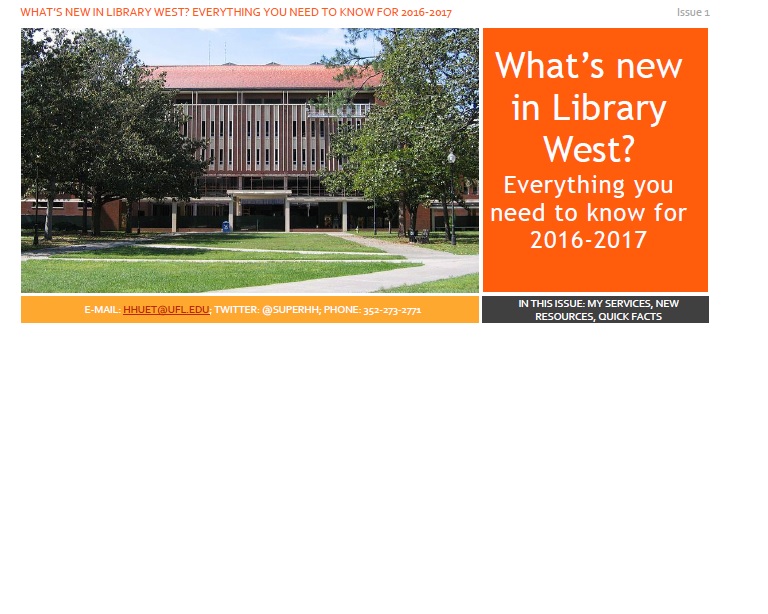
My Spring 2017 newsletter for European Studies at the University of Florida is out. Enjoy.
Postdoctoral Fellow in Caribbean Studies Data Curation at UF
Guess what? The University of Florida is partnering with CLIR to offer a CLIR/DLF Postdoctoral Fellowship in Data Curation for Latin American and Caribbean Studies.
RANK: Postdoctoral Fellow
REPORTS TO: Digital Scholarship Librarian
SALARY: Salary is $65,000
TIME-LIMITED: This is a time-limited position for two years, funded by the Council on Library & Information Resources (CLIR) Postdoctoral Fellowship in Latin American and Caribbean Studies, 2017-2019.
JOB SUMMARY
The George A. Smathers Libraries seeks a Postdoctoral Fellow in Caribbean Studies Data Curation to serve the University of Florida (UF), a major, comprehensive, land-grant, research university, which is among the nation’s most academically diverse public universities. The successful candidate will, as part of a dynamic and collaborative team, develop data curation services for Caribbean Studies.[1] The candidate will develop new initiatives in data curation and forge new collaborations and relationships that extend the Libraries’ capacity to support the University’s interdisciplinary research and technology initiatives – building upon a foundation of library-campus collaboration to date and work of the Data Management/Curation Working Group, Latin American & Caribbean Collections, and UF’s role as a founding partner and technical host for the international collaborative Digital Library of the Caribbean (dLOC).
Reporting to the Digital Scholarship Librarian (also the dLOC Digital Scholarship Director), the Postdoctoral Fellow will contribute to the development of long-term data management infrastructure for specific needs for Caribbean Studies; liaise with internal and external experts in Caribbean Studies to identify needs for data curation; liaise with the dLOC team to extend supports and content within dLOC; and serve as a consultant with researchers on Caribbean Studies data curation data issues. The Postdoctoral Fellow will collaborate with the dLOC Digital Scholarship Director, dLOC Technical Director, UF Data Management Librarian, and UF Latin American & Caribbean Collections Librarians and Archivists to develop and conduct trainings for librarians, archivists, and researchers on data curation practices, resources, and processes from a situated perspective for Latin American & Caribbean Studies.
The Postdoctoral Fellow will join the existing team that is building a full system (with training, outreach, liaison duties, policies, procedures, technologies, tools, workflows, etc.) of data curation, and will support extending and enriching the team by contributing subject-specific knowledge from Caribbean Studies. As part of the dynamic team, the Postdoctoral Fellow in Caribbean Studies Data Curation will serve as the primary liaison for and provide consulting support to identify, store, describe (curate), retrieve, and re-use data for Caribbean Studies, particularly data not available in public or government repositories and especially for creating the attendant intellectual infrastructure through a mix of activities ad products (e.g., database entries in dLOC, webinars, teaching, supervising interns, policy development, procedure and workflow development and refinement).
The Postdoctoral Fellow will have the opportunity to lead new initiatives, including the new partnership with the UF Press for supporting enhanced monographs by hosting data sets, online exhibits, archival research materials, and other research files within dLOC as part of new scholarly publications. The Postdoctoral Fellow will serve as a core contact with the UF Press to implement services and workshops on data curation as part of creating enhanced monographs, journal articles, book chapters, and other publications with dLOC as the data repository.
The successful candidate will perform outreach and facilitate communication between the Libraries and Caribbean Studies research groups at UF as well as Caribbean Studies researchers and partners in dLOC. The Postdoctoral Fellow will pursue professional development opportunities, including research, publication, and professional service activities in accordance with the standards for library faculty; serve as a Principal Investigator (PI), co-PI or grant team member on externally funded projects; and engage in research and professional activity at the national and international level.
RESPONSIBILITIES
REPORTS TO: Digital Scholarship Librarian
SALARY: Salary is $65,000
TIME-LIMITED: This is a time-limited position for two years, funded by the Council on Library & Information Resources (CLIR) Postdoctoral Fellowship in Latin American and Caribbean Studies, 2017-2019.
JOB SUMMARY
The George A. Smathers Libraries seeks a Postdoctoral Fellow in Caribbean Studies Data Curation to serve the University of Florida (UF), a major, comprehensive, land-grant, research university, which is among the nation’s most academically diverse public universities. The successful candidate will, as part of a dynamic and collaborative team, develop data curation services for Caribbean Studies.[1] The candidate will develop new initiatives in data curation and forge new collaborations and relationships that extend the Libraries’ capacity to support the University’s interdisciplinary research and technology initiatives – building upon a foundation of library-campus collaboration to date and work of the Data Management/Curation Working Group, Latin American & Caribbean Collections, and UF’s role as a founding partner and technical host for the international collaborative Digital Library of the Caribbean (dLOC).
Reporting to the Digital Scholarship Librarian (also the dLOC Digital Scholarship Director), the Postdoctoral Fellow will contribute to the development of long-term data management infrastructure for specific needs for Caribbean Studies; liaise with internal and external experts in Caribbean Studies to identify needs for data curation; liaise with the dLOC team to extend supports and content within dLOC; and serve as a consultant with researchers on Caribbean Studies data curation data issues. The Postdoctoral Fellow will collaborate with the dLOC Digital Scholarship Director, dLOC Technical Director, UF Data Management Librarian, and UF Latin American & Caribbean Collections Librarians and Archivists to develop and conduct trainings for librarians, archivists, and researchers on data curation practices, resources, and processes from a situated perspective for Latin American & Caribbean Studies.
The Postdoctoral Fellow will join the existing team that is building a full system (with training, outreach, liaison duties, policies, procedures, technologies, tools, workflows, etc.) of data curation, and will support extending and enriching the team by contributing subject-specific knowledge from Caribbean Studies. As part of the dynamic team, the Postdoctoral Fellow in Caribbean Studies Data Curation will serve as the primary liaison for and provide consulting support to identify, store, describe (curate), retrieve, and re-use data for Caribbean Studies, particularly data not available in public or government repositories and especially for creating the attendant intellectual infrastructure through a mix of activities ad products (e.g., database entries in dLOC, webinars, teaching, supervising interns, policy development, procedure and workflow development and refinement).
The Postdoctoral Fellow will have the opportunity to lead new initiatives, including the new partnership with the UF Press for supporting enhanced monographs by hosting data sets, online exhibits, archival research materials, and other research files within dLOC as part of new scholarly publications. The Postdoctoral Fellow will serve as a core contact with the UF Press to implement services and workshops on data curation as part of creating enhanced monographs, journal articles, book chapters, and other publications with dLOC as the data repository.
The successful candidate will perform outreach and facilitate communication between the Libraries and Caribbean Studies research groups at UF as well as Caribbean Studies researchers and partners in dLOC. The Postdoctoral Fellow will pursue professional development opportunities, including research, publication, and professional service activities in accordance with the standards for library faculty; serve as a Principal Investigator (PI), co-PI or grant team member on externally funded projects; and engage in research and professional activity at the national and international level.
RESPONSIBILITIES
- Contributes to university-wide initiatives to develop and design policies, services, and infrastructure to enable faculty and students to preserve and make available, and thus maximize the utility of, their research data.
- Collaborates on the development and delivery of onsite and online/webinar trainings in Caribbean Studies data curation.
- Collaborates on the development and teaching of for-credit courses, as applicable, in Caribbean Studies data curation.
- Provides training for UF students, faculty, and staff and dLOC partners on data curation best practices and standards, and available UF and dLOC services.
- Serves as a member of the UF-dLOC team to facilitate campus-wide data curation activities and initiatives; and, serve as a member of the dLOC team to facilitate data curation activities and initiatives across the dLOC community.
- Works closely with the Digital Production Services and other entities (e.g. dLOC, other partners, other organizations) on relevant digitization projects.
- Collaboratively supports decisions or recommendations on cataloging, location, preservation, maintenance, and retention of library resources and data for curation.
- Formally assesses, through surveys, interviews, and focus groups, campus-wide and dLOC community data curation needs and current support resources and activities.
- Works with library departments, technical experts, and the dLOC community to develop infrastructures and services that enhance access to Caribbean Studies data.
- Partners with UF units and the dLOC community to implement Caribbean Studies data curation and publishing services and workshops.
- Partners with the UF Press to implement services and workshops on data curation as part of creating enhanced monographs, journal articles, book chapters, and other publications with dLOC as the data repository.
- Performs outreach using a variety of methods and tools to actively promote activities, events, and initiatives.
- Serve as a core library consultant to UF and dLOC community faculty, researchers, and project teams as a collaborative team member for data curation throughout the research process.
- Develops and maintains awareness of current tools and methodologies for computationally centered, data-driven research (data mining, visualization, text mining, etc.).
- Develops and maintains awareness of emerging trends and best practices in Caribbean Studies, digital humanities, data curation, and e-scholarship in all disciplines.
- Participates in appropriate professional organizations on the state, regional, national, and international levels and pursues professional development goals, including publication.
QUALIFICATIONS
Required:
- PhD in a relevant field
- Fluency in English as well as Spanish and/or French
- Ability to significantly contribute to the development and implementation of a vision for a Caribbean Studies data curation program
- Ability to creatively develop, assess, and promote the use of library services, technologies, and collections
- Excellent interpersonal skills including the ability to work effectively with individuals at all levels
- Excellent oral and written communication skills
- Ability to initiate and manage collaborative projects including the development of policies
- Strong interest in collaborating on grants
- Strong interest in the development and delivery of training
- Capacity to work creatively in a complex, rapidly changing academic environment and to respond with agility to changing needs and priorities
- Instruction or teaching experience
- Successful track record of collaboration regarding scholarly issues and/or technologies
- Strong commitment to diversity, equity, and inclusion
Preferred:
- Successful track record in project development and management
- Grant experience
- Knowledge of funding agency requirements for data management plans
- Professional experience with issues and technical challenges related to the life cycle of research data and digital curation
- Demonstrated experience employing data curation and digital curation practices and technological applications to enhance library management and access
- Experience with digital preservation standards and best practices and knowledge of repository platforms
- Experience with web technologies
- Experience with metadata issues related to the discovery of academic resources
GUIDANCE AND PROFESSIONAL DEVELOPMENT SUPPORT
- Regular meetings with supervisor
- Regular team meetings with digital scholarship, data management, digital libraries, Latin American & Caribbean Collections, and the Digital Library of the Caribbean (dLOC)
- Introductions to national and international leaders through participation in conferences
- Grants Management training and support from the UF Libraries’ Grants Manager
- UF’s and the Libraries’ Professional Development opportunities
- Support for development and delivery of training from the UF Libraries’ Instruction Consultant and Training Program Coordinator
- Opportunities and support as part of the collaborative team on the campus-wide Data Management/Curation Working Group and the Digital Humanities Working Group
- Opportunity for joint appointment with the Center for Latin American Studies and affiliate faculty with the UF Informatics Institute, each with additional grant and professional development opportunities
THE UNIVERSITY OF FLORIDA
The University of Florida (UF) is a major, public, comprehensive, land-grant, research university. The state’s oldest and most comprehensive university, UF is among the nation’s most academically diverse public universities. UF has a long history of established programs in international education, research and service. It is one of only 17 public, land-grant universities that belong to the Association of American Universities. UF traces its beginnings to a small seminary in 1853 and is now one of the largest universities in the nation, with more than 50,000 students. For more information, please consult the UF homepage at http://www.ufl.edu. UF launched the UF Rising initiative in 2014 to bring UF to national preeminence with strategic hires and investments across the university. UF Rising’s largest single investment is in the new UF Informatics Institute, with other strategic investments in bioinformatics and other areas that leverage UF’s excellence for its diversity, complexity, and comprehensiveness. For more on UF Rising, see: http://rising.ufl.edu/.
GEORGE A. SMATHERS LIBRARIES
The libraries of the University of Florida form the largest information resource system in the state of Florida. The UF Libraries consist of seven libraries; six are in the system known as the George A. Smathers Libraries at the University of Florida. The libraries hold over 5,800,000 print volumes, 8,100,000 microfilms, 630,000 e-books, 121,016 full-text electronic journals, 889 electronic databases, 1,300,000 documents and 766,000 maps and images. The libraries have built a number of nationally significant research collections, including the Latin American & Caribbean, Judaica, Florida History, Children’s Literature, and Maps and Imagery Collections. The Smathers Libraries are a member of the Association of Research Libraries (ARL), the Center for Research Libraries (CRL), the Association of Southeastern Research Libraries (ASERL), and LYRASIS. The library staff consists of more than 400 FTE librarians, technical/clerical staff and student assistants. The organizational chart is available at http://www.uflib.ufl.edu/orgchart.pdf.
The UF Libraries have a long-standing history of excellence in digital curation with the UF Digital Collections along with collaborations across campus for digital humanities, digital scholarship, and data management and curation activities. For recent news, see: http://acrl.ala.org/dh/2014/07/23/intertwingularity-digital-humanities-university-florida/. The UF Libraries led creation of the campus-wide Data Management and Curation Task Force which started in 2012 (which became the Data Management and Curation Working Group in 2016) with representatives from the Libraries, Research Computing, and the Office of Research.
DIGITAL LIBRARY OF THE CARIBBEAN (dLOC)
UF is a founding partner and the technical host of the international Digital Library of the Caribbean (dLOC). Since creation in 2004, dLOC has into the largest open access collection of Caribbean materials with over 2 million pages of content, 42 institutional partners, and over 3 million views each month. dLOC is founded on a core of shared governance where all activities are governed by partner institutions with an equitable and partner-driven model where partners retain all rights to materials and determine all materials to contribute. dLOC partners commit to shared values for community and capacity development. Now in its second decade, dLOC focuses on digitization, digital curation for collection development, and skill and capacity development to support building intellectual infrastructure, teaching resources, integrated approaches to teaching, digital scholarship, and collaboration with scholars for new initiatives and programmatic supports. dLOC provides training and collaborates with partners to pursue new funding opportunities and initiatives, including data curation.
RESEARCH COMPUTING AND THE OFFICE OF RESEARCH
UF created Research Computing in 2011, with the vision to enable radical collaboration across campus. UF was the first university to fully connect to the Internet2 Innovation Platform’s three components. Research Computing is home to HiPerGator, the state’s most powerful supercomputer. For more on Research Computing, see: http://www.rc.ufl.edu/. In 2013, the Office of Research supported the over 5,000 funding awards for a total of over $640 million in sponsored research funding. For more, see: http://research.ufl.edu/.
COMMUNITY
Gainesville, Florida and the surrounding community are home to approximately 257,000 people and both the University of Florida and Santa Fe College. Situated just over an hour from the Gulf of Mexico and the Atlantic Ocean, the city is surrounded by over 40 nature parks, including many spring-fed lakes and rivers. In 2015, Gainesville was named the “Best Midsize College City in America” by WalletHub and ranked no. 7 on Livability.com “Top 10 College Towns”. Gainesville is known as an innovative municipal government and an innovative city. Gainesville continues to receive national recognition as a top-rated city. Some of Gainesville’s accolades are listed at the Gainesville Awards and Recognition link. The Guide to Greater Gainesville combines award winning photography and compelling articles that capture all of the reasons for calling Greater Gainesville your next home. The area has numerous cultural institutions and is a haven for sports fans. Jacksonville, Orlando, Tampa, Tallahassee, and St. Augustine are all within a two-hour drive.
BENEFITS
Vacation days, paid holidays, and sick leave days; retirement plan options; insurance benefits; tuition fee waiver program; no state or local income tax. Prospective employees should review the information about employment and benefits at UF available at http://hr.ufl.edu/benefits/.
[1] Caribbean Studies as defined by the Association of Caribbean University, Research and Institutional Libraries (ACURIL) as “within the area of the Caribbean archipelago, the mainland countries including the Guianas, and the states of the United States which border on the Caribbean Sea or Gulf of Mexico” (https://goo.gl/DHSrxa).
Graduate Student Research Series Act II
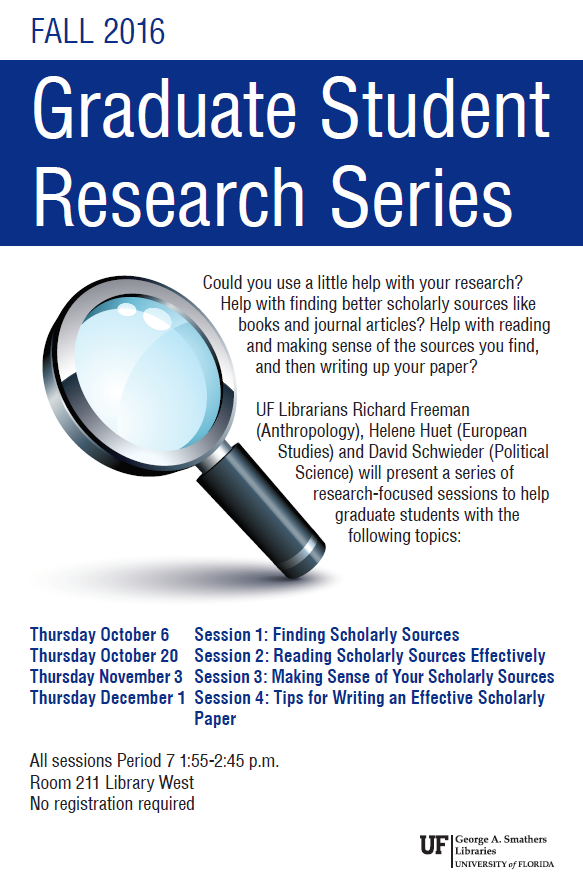
Join UF Librarians Richard Freeman (Anthropology), Hélène Huet (European Studies), and David Schwieder (Political Sciences) this Thursday for session 2 of our new Graduate Students research Series. This session will offer students tips for reading scholarly sources effectively. The session will be Period 7 (1:55-2:45 p.m.) in Room 211, Library West. No registration required. Join us!
Position Vacancy Announcement: Lecturer in Spanish – UF Online
The Department of Spanish and Portuguese Studies at the University of Florida and University of Florida Online seek an instructor at the rank of Lecturer. This is a 12-month, time-limited, renewable, non-tenure-track position. The start date is August 16, 2017. The successful candidate will teach and coordinate the UF Online Beginning Spanish 1 and 2 courses (SPN1130, SPN1131) each Fall, Spring, and Summer C semester.
Responsibilities of the position include:
- Developing and designing course curricula and materials in accordance with the goals of the Lower Division Language Program and in collaboration with the Director of Language Instruction;
- Assisting with the selection of graduate student instructors (GTAs) to teach online courses each semester;
- Training GTAs and instructors in the practice of online language teaching (including creating materials for GTA/instructor success, such as an online teaching handbook and an observation protocol to evaluate online classes);
- Training GTAs and instructors in the effective integration of current technologies in Lower Division Language Program courses;
- Supervising GTAs, including regular performance observations and evaluations (approximately 2-5 GTAs will work with these courses in any given year)
- Serving on departmental and university committees as assigned by the Chair of the Department of Spanish and Portuguese Studies.
The University of Florida is an equal opportunity institution dedicated to building a broadly diverse and inclusive faculty and staff. Searches are conducted in accordance with Florida’s Sunshine Law. If an accommodation due to disability is needed to apply for this position, please call (352) 392-2477 or the Florida Relay System at (800) 955-8771 (TDD).
Salary will be competitive, commensurate with qualifications and experience, and include a full benefits package.
The ideal candidate will have: a PhD or EdD in Spanish or closely related field (MA or MEd may be considered if other materials are outstanding); demonstrated excellence as a teacher in an online environment; familiarity with educational technologies used in language teaching and learning; native or native-like fluency in English and Spanish; residency in or willingness to move to Gainesville, FL.
Additional desirable qualities include: proven commitment to Computer-Assisted Language Learning; experience as a supervisor and/or administrator in a college-level language program; working knowledge of Portuguese.
For full consideration, applications must be submitted online at http://explore.jobs.ufl.edu/cw/en-us/job/499024/lecturer-uf-online/ and must include: (1) a letter summarizing the applicant’s qualifications, ongoing research directions (as applicable), and interests in the Department, (2) a complete curriculum vitae, (3) a teaching statement, (4) teaching materials relevant to online instruction created by the candidate (for example, a sample syllabus and/or 2-3 lesson plans), and (5) course evaluations demonstrating excellence in online teaching. In addition, names and email address for three references must be provided on the application. An email will be sent automatically to your references, requesting them to upload their letters. To ensure full consideration, application materials should be received by November 7, 2016. The committee will continue to review applications until the position is filled. You may send email inquiries about the position to Jennifer Wooten (wooten@ufl.edu), but be aware that all materials must be submitted via the online application as outlined above.
The final candidate will be required to provide an official transcript to the hiring department upon hire. A transcript will not be considered “official” if a designation of “Issued to Student” is visible. Degrees earned from an educational institution outside of the United States require evaluation by a professional credentialing service provider approved by the National Association of Credential Evaluation Services (NACES), which can be found at http://www.naces.org/.