Category Archives: Digital Humanities

2018 UF Conference on Comics and Graphic Novels "ImageTech"

2018 UF Conference on Comics and Graphic Novels
“ImageTech”

On April 6th-8th, 2018, UF will be hosting its 15th annual Conference on Comics and Graphic Novels, “ImageTech: Comics and Materiality” in Gainesville, Florida.

Call For Papers

The Graduate Comics Organization at the University of Florida invites applicants to submit proposals to the 15th UF Conference on Comics and Graphic Novels, “ImageTech: Comics and Materiality.” The conference will be held from Friday, April 6 through Sunday, April 8, 2018.
The medium of comics has always prompted comics creators to work in concert with, and push against, the technologies through which their works are produced and distributed. As print and digital technologies have become more sophisticated, accessible, and affordable, some comics creators have embraced innovative digital technologies, while others prefer pen and ink on paper. From the meticulous series of woodblock prints, to the humble black-and-white photocopied zine, to the decade-long online epic, comics are fundamentally concerned with technologically-determined formats and materiality.
The goal of this conference is to not only explore relationships among comics and various technologies, but to interrogate the digital/analog divide in comics creation and scholarship. How does form dictate content, and vice versa? How do digital platforms impact engagement and accessibility? How do changes, improvements, and advances in technologies push comics creators and scholars to reevaluate our understanding of comics as a medium? Why do some comics creators deliberately adhere, or return, to analog technologies? In short: how do we understand and approach the material considerations of comics?
Possible topics include, but are not limited to:

  • Digital comics (comics created and/or hosted/distributed digitally)
  • Print forms and “legitimacy” (monetization, privileged status of print)
  • Comics thematically or visually concerned with technologies (steampunk, cyberpunk)
  • Comics incorporating elements of other media (flash animation, animated gifs)
  • Augmented Reality (AR) and Virtual Reality (VR) comics
  • Comics made using unusual/older technologies (wood-block prints, paper cut-outs, collage, found materials) and/or creators’ use of disparate technologies
  • Zines or other periodicals that incorporate comics
  • Transitions in specific comics series from print to digital or from digital to print (potential problems/losses, transitioning forms as “translation,” introduction or removal of page turns and/or gutters)
  • Impact of social media on proliferation of image-texts (reblogs, memes, remixes, fandom/fan art, fan/composer dialogues)
  • Format and accessibility (hosting platforms, open source vs. paywalls, ads, digital copying, replication/reproduction, coding, easter eggs)
  • Comics as a format for critical scholarship

Presentations should be 15-20 minutes in length and must be delivered in English. “ImageTech” also invites creative projects related to the conference theme. Discussion panels from multiple presenters coordinated around a central topic or theme are welcome. Proposals of 200-300 words, plus a short bio and A/V requirements, should be submitted to gco@english.ufl.edu by December 15th, 2017.

LACC hosts ARL Fellowship for Digital and Inclusive Excellence Recipient

The Latin American and Caribbean (LACC) is hosting Katiana Bagué, recipient of the Association of Research Libraries (ARL) Fellowship for Digital and Inclusive Excellence, during the 2017-2018 academic year. The objective of this initiative is to expose undergraduate students from underrepresented communities to the field of librarianship and digital scholarship in order to promote diversification in the library science profession.

Bagué is a fourth-year art history student at the University of Florida in Gainesville. While she specialized in Latin American art, she worked at LACC supporting public services, curating book exhibits, processing colonial Latin American manuscripts and researching Latin American books and material culture. Under the supervision of Margarita Vargas-Betancourt, Ph.D., UF Latin American and Caribbean Special Collections Librarian, and Hélène Huet, Ph.D., UF European Studies Librarian, Katiana will use art history knowledge to challenge underrepresentation in the library science profession.

For more information on the program, visit the ARL website. To see the current roster of fellows, see here.

50th anniversary of Dian Fossey's Karisoke Research Center: Online and Offsite Exhibit at UF

My colleagues Dan Reboussin and Richard Freeman are currently curating an exhibit to commemorate the 50th anniversary of Dian Fossey’s Karisoke Research Center, where Fossey studied wild mountain gorillas in the Virunga Mountains of Rwanda until her death in 1985. Several of the 30 beautiful photographs on display (by photographer Bob Campbell) were featured in two National Geographic magazine cover stories that propelled Fossey to international recognition in the early 1970s.
The Sept. 2017 issue of National Geographic and a 3 part NatGeo Channel television series narrated by Sigourney Weaver scheduled for December also feature several of the images currently on display here at UF. On view until December 15th, 2017 the exhibit is located in the first-floor lobby of Smathers Library.
An online exhibit is also available at http://exhibits.uflib.ufl.edu/BobCampbell. Selected digitized images from the collection of 15,000 original slides are available in UF Digital Collections at http://ufdc.ufl.edu/wildlife.

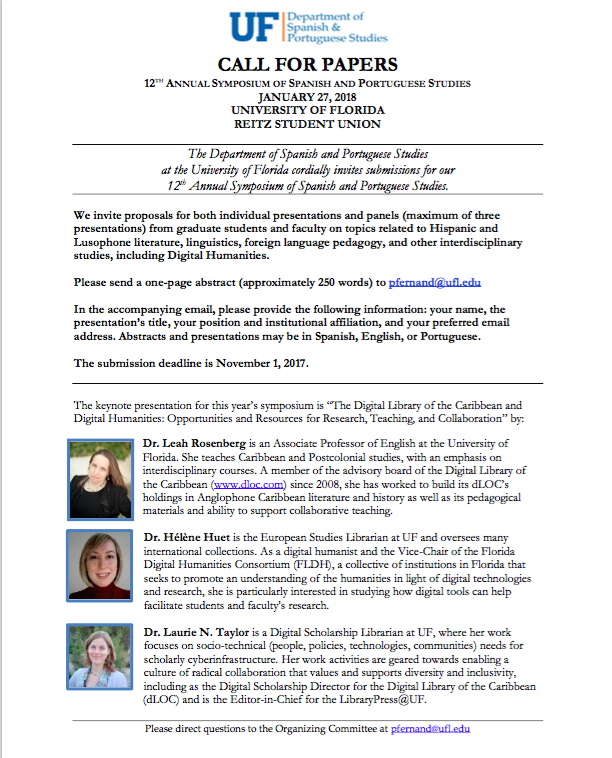
12th Annual Symposium of Spanish and Portuguese Studies. January 27, 2018

CALL FOR PAPERS

12th Annual Symposium of Spanish and Portuguese Studies

January 27, 2018 at the University of Florida, Reitz Student Union

The Department of Spanish and Portuguese Studies at the University of Florida cordially invites submissions for our 12th Annual Symposium of Spanish and Portuguese Studies.
We invite proposals for both individual presentations and panels (maximum of three presentations) from graduate students and faculty on topics related to Hispanic and Lusophone literature, linguistics, foreign language pedagogy, and other interdisciplinary studies, including Digital Humanities.
Please send a one-page abstract (approximately 250 words) to pfernand@ufl.edu
In the accompanying email, please provide the following information: your name, the presentation’s title, your position and institutional affiliation, and your preferred email address. Abstracts and presentations may be in Spanish, English, or Portuguese.
The submission deadline is November 1, 2017.
The keynote presentation for this year’s symposium is “The Digital Library of the Caribbean and Digital Humanities: Opportunities and Resources for Research, Teaching, and Collaboration” by:
Dr. Leah Rosenberg is an Associate Professor of English at the University of    Florida. She teaches Caribbean and Postcolonial studies, with an emphasis on interdisciplinary courses. A member of the advisory board of the Digital Library of the Caribbean (www.dloc.com) since 2008, she has worked to build its dLOC’s holdings in Anglophone Caribbean literature and history as well as its pedagogical materials and ability to support collaborative teaching.
Dr. Hélène Huet is the European Studies Librarian at UF and oversees many international collections. As a digital humanist and the Vice-Chair of the Florida Digital Humanities Consortium (FLDH), a collective of institutions in Florida that seeks to promote an understanding of the humanities in light of digital technologies and research, she is particularly interested in studying how digital tools can help facilitate students and faculty’s research.
Dr. Laurie N. Taylor is a Digital Scholarship Librarian at UF, where her work focuses on socio-technical (people, policies, technologies, communities) needs for scholarly cyberinfrastructure. Her work activities are geared towards enabling a culture of radical collaboration that values and supports diversity and inclusivity, including as the Digital Scholarship Director for the Digital Library of the Caribbean                                         (dLOC) and is the Editor-in-Chief for the LibraryPress@UF.
Please direct questions to the Organizing Committee at pfernand@ufl.edu

PhotoKeynote

Poster of the Call for Papers


New Position: Digital Scholarship Associate – Library Associate 2

POSITION VACANCY ANNOUNCEMENT
POSITION: Digital Scholarship Associate – (Library Associate 2)
REPORTS TO: Associate Chair, Humanities and Social Science Library (Library West)
SALARY: $39,529 annual salary; Actual rate will reflect experience and credentials
REQUISITION #: 503537
DEADLINE DATE: September 12, 2017
JOB SUMMARY
The Digital Scholarship Associate (DS Associate) ensures coordinated and consistent activities for instruction and outreach in Library West, especially in regards to the new and expanded needs for support with digital humanities and digital scholarship. The DS Associate is responsible for coordinating and supporting Library West’s web and social media presence, the Scott Nygren Scholars Studio, trainings and activities related to digital humanities and digital scholarship as centered in Library West and across the Libraries, and in providing support to academic faculty collaborating with the Libraries on digital humanities efforts. Each week, the DS Associate will spend 10 hours in the Scott Nygren Scholars Studio, a dynamic new digital humanities and scholarship lab, to assist and/or advise faculty, staff, and students of the UF community on digital projects in collaboration with the Libraries and to hold open hours for the Studio for drop-in visitors. The DS Associate will become an expert on using the technology and software in the Studio, and is responsible for planning, coordinating, and providing training on software and technology located in and accessible from the Studio.
The DS Associate will also serve as a member of the instruction and outreach team to provide reference and instructional services. The person in this position will perform research assistance duties such as staffing the Research Assistance desk and Ask-A-Librarian. The DS Associate also participates in state and/or national conferences on an annual basis.
RESPONSIBILITIES
Digital scholarship support
– Manages the Scott Nygren Scholars Studio (Library West 212), maintaining the space and technology.
– Schedules and holds lab hours in the Studio for 10 hours each week.
– Collaborates with librarians interested in digital humanities and closely with the Instruction & Outreach Coordinator.
– Demonstrates understanding and works toward proficiency in core digital humanities software installed in the Studio.
– Assists members of the UF community and instructs on use of the equipment and software available in the studio. Offers regular trainings on digital humanities software and citation management software (e.g. RefWorks).
– Engages and participates in digital humanities and scholarship projects with librarians and library staff. Stays current in best practices for digital scholarship and is familiar with a wide variety of academic digital projects across the nation and world.
– Plans, recruits trainers from within the Libraries and across UF as appropriate, assists trainers in obtaining access to software, equipment and other resources needed for training.
– Provides and coordinates support for non-credit and for-credit trainings and courses in digital humanities and digital scholarship.
– Coordinates and supports planning and implementing events and activities in support of the digital humanities at UF, including supporting such groups as the Center for the Humanities and the Public Sphere, the Digital Humanities Working Group, and the Center for Media Innovation and Research.
Library West Web coordinator and social media manager
– Updates the Library West website (http://cms.uflib.ufl.edu/librarywest/Index.aspx) and all pages under Library West, in collaboration with the Information Commons Librarian.
– Collaborates with the Libraries’ webmasters.
– Maintains an active, positive social media presence representing Library West on a variety of social media sites including Twitter, Instagram, Facebook, and other media outlets.
– Coordinates social media activities with the Social Media Coordinator
– Acts as a liaison between Library West and UF Social Media.
– Maintains compliance with UF social media policies, and Libraries and UF web standards, policies, and practices.
Reference and instructional services
– Assists users at the Library West Research Assistance Desk in locating library materials and instructs them in the use of: online information sources, the online catalog, the course reserves system, interlibrary loan, and basic reference materials and methods.
– Provides knowledgeable and excellent assistance to patrons of the UF Libraries.
– Holds regular shifts for the Ask a Librarian chat, email, and texting reference service and other non-traditional reference services, in addition to traditional desk services.
– Makes appropriate referrals for research assistance, instruction, and materials request to subject specialists and other branch libraries and departments.
– Assists with the Library Instruction Program, mentoring Graduate Student Teaching Assistants, teaching classes ENC 1101-1102.
– Assists and supports librarians with subject specific classes in the humanities and social sciences.
– Serves as resident expert on bibliographic citation software, such as RefWorks.
Other Duties as Assigned
– Serves on various committees and task forces at the Library and University level.
– Encouraged to attend and/or present at state and national conferences.
QUALIFICATIONS
Required
– Bachelor’s degree and four years of related library experience; or a Master’s degree and two years of related library experience; or any equivalent combination of experience, training and/or education.
Preferred
– Excellent written and oral communication skills and the ability to work effectively independently as well as collaboratively in a team-based environment.
– Excellent organizational skills and a demonstrable ability to manage multiple priorities.
– Ability to effectively serve a large and diverse user population.
– Experience working with social media tools (e.g., Twitter, Facebook, blogs, YouTube, Wikis) as part of managing web presence.
– Experience managing web presence using web authoring and editing technologies (e.g., content management systems, blogging, HTML and CSS).
– Experience with text encoding and markup (e.g., HTML, CSS, markdown, TEI, etc.).
– Experience with graphics programs (e.g., Adobe Creative Suite).
– Experience with video recording and editing technology.
– Experience with digital scholarship and digital humanities technologies in use with digital libraries (e.g., SobekCM, Omeka).
– Familiarity with technologies used to support text mining, text analysis, and topic modeling (e.g., Python, R, Mallet).
– Familiarity with UFapps (e.g., http://info.apps.ufl.edu/) and UF resources for processes involved in digital scholarship (e.g., file sharing with GatorCloud http://www.it.ufl.edu/gatorcloud/, OneDrive, and File-Express https://file-express.ufl.edu/).
– Familiarity with Research Computing technologies and processes (e.g., http://www.rc.ufl.edu/help/getting-started/) .
– Strong analytical skills and experience in planning and setting priorities.
– Experience in project management and project portfolio management for simultaneously managing multiple projects.
– Knowledge and experience working in an academic library setting, including basic reference skills and familiarity with major information sources in print and electronic.
– Demonstrated ability to remain conversant with newly evolving technologies.
THE UNIVERSITY OF FLORIDA The University of Florida (UF) is a major, public, comprehensive, land-grant, research university. The state’s oldest and most comprehensive university, UF is among the nation’s most academically diverse public universities. UF has a long history of established programs in international education, research and service. In 2013 the Florida Legislature designated UF as the state’s preeminent institution which grew into an opportunity to achieve national and international recognition for the University’s work in serving students and the world. It is one of only 17 public, land-grant universities that belong to the Association of American Universities. UF traces its beginnings to a small seminary in 1853 and is now one of the largest universities in the nation, with more than 50,000 students. For more information, please consult the UF homepage at http://www.ufl.edu.
UNIVERSITY OF FLORIDA LIBRARIES
The libraries of the University of Florida form the largest information resource system in the state of Florida. The UF Libraries consist of seven libraries on the Gainesville campus and three off-campus facilities; six of the campus libraries, and all of the off-site facilities, are in the system known as the George A. Smathers Libraries at the University of Florida. The remaining library is the Lawton Chiles Legal Information Center. Collectively, the UF Libraries (the Smathers Libraries and the Legal Information Center) hold or provide access to over 5.45 million print volumes, 8,100,000 microfilms, 1.25 million e-books, over 152,000 full-text electronic journals, over 1100 electronic databases, 1.26 million documents and 1.35 million maps and images.
The UF Libraries have built a number of nationally significant research collections, including the Latin American, Judaica, Florida History, Children’s Literature, and Maps and Imagery collections. The UF Libraries are a member of the Association of Research Libraries (ARL), the Center for Research Libraries (CRL), and the Association of Southeastern Research Libraries (ASERL). The library staff consists of more than 300 FTE librarians, technical/clerical staff and student assistants. The organizational chart is available at http://www.uflib.ufl.edu/orgchart.pdf.
The George A. Smathers Libraries are strong advocates for inclusion and intellectual freedom. The Libraries’ commitment to both is articulated in the Inclusion Statement and Intellectual Freedom Statement, both of which are posted at http://cms.uflib.ufl.edu/InclusionAndIntellectualFreedom.
HUMANITIES AND SOCIAL SCIENCES LIBRARY (Library West)
The Humanities and Social Sciences Library (Library West) is the largest branch library on the UF campus, with 14 faculty and 16 staff members, seating for 1,400 patrons, and 217 public computers, including iPads and Netbook laptops. Last year, Library West received over 1.4 million visitors. Renovated in 2006, the branch offers 16 group study rooms, 3 media rooms, including video conferencing facilities, faculty and graduate carrels as well as a limited-access floor for graduate students. Two classrooms are available, one with auditorium-style seating and the other with 19 computers for hands-on instruction. Within the branch, there are four functional units: Research Assistance, Instruction and Outreach, Collections, and Circulation; these units are managed by coordinators who oversee the daily functions. Programs and lectures are scheduled throughout the year in the Information Commons area. The branch is also home to the Libraries Administration, Human Resources and Fiscal Services, Library Facilities Planning, and the Access Support unit providing ILL and Reserves services for all branches. A Starbucks is located in the building. Organizational chart available at: http://cms.uflib.ufl.edu/portals/librarywest/LibraryWestOrganization20140623.pdf.
COMMUNITY
Gainesville, Florida and the surrounding community are home to approximately 257,000 people and both the University of Florida and Santa Fe College. Situated just over an hour from the Gulf of Mexico and the Atlantic Ocean, the city is surrounded by over 40 nature parks, including many spring-fed lakes and rivers. In 2015, Gainesville was named the “Best Midsize College City in America” by WalletHub and ranked no. 7 on Livability.com “Top 10 College Towns”. Gainesville is known as an innovative municipal government and an innovative city. Gainesville continues to receive national recognition as a top-rated city. Some of Gainesville’s accolades are listed at the Gainesville Awards and Recognition link. The Guide to Greater Gainesville combines award winning photography and compelling articles that capture all of the reasons for calling Greater Gainesville your next home. The area has numerous cultural institutions and is a haven for sports fans. Jacksonville, Orlando, Tampa, Tallahassee, and St. Augustine are all within a two-hour drive.
BENEFITS
Vacation days, paid holidays, and sick leave days; retirement plan options; insurance benefits; tuition fee waiver program; no state or local income tax. Prospective employees should review the information about employment and benefits at UF available at http://hr.ufl.edu/benefits/new-employees/.
APPLICATION PROCESS
To apply, submit 1) a cover letter detailing your interest in and qualifications for this position; 2) your current resume or CV; and 3) a list of three references including their contact information (address, telephone number, and email). Apply by September 12, 2017 (applications will be reviewed as received). Submit all application materials through the Jobs at UF online application system at Requisition 503537. If you have questions about the application process please contact Tina Marie Litchfield, tlitchfield@uflib.ufl.edu.
AFFIRMATIVE ACTION/EEO
The University of Florida is an Affirmative Action, Equal Opportunity Employer and encourages applications from women and minority group members. We are dedicated to the goal of building a culturally diverse and pluralistic environment; we strongly encourage applications from women, members of underrepresented groups, individuals with disabilities, and veterans. As part of the application process, applicants are invited to complete an on-line confidential and voluntary demographic self-disclosure form which can be found at: http://www.hr.ufl.edu/job/datacard.htm. This information is collected by the University of Florida’s Office of Human Resources to track applicant trends and is in no way considered by the Smathers Libraries in the selection process.
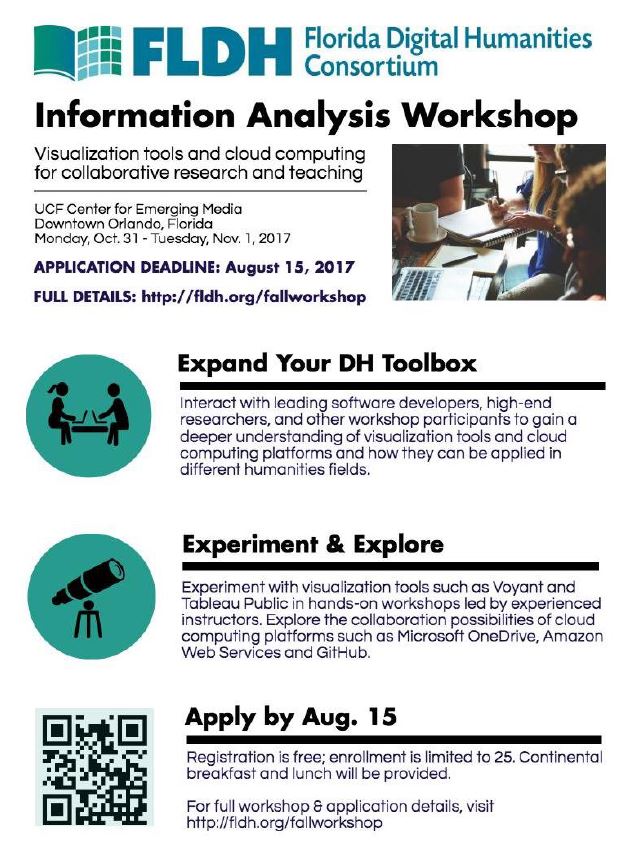
Workshop Announcement: Information Analysis: The Role of Visualization Tools and Cloud Computing Platforms in Collaborative Research and Teaching

It is my pleasure to announce the following FLDH sponsored workshop that will take place just before HASTAC 2017.Capture.
See here the full workshop announcement: http://fldh.org/fallworkshop/

Symposium, Collaborating Across the Divide: Digital Humanities and the Caribbean, Sept. 21-22, 2017 University of Florida

Please save the date for the upcoming symposium:
Collaborating Across the Divide: Digital Humanities and the Caribbean
Date: September 21 and 22
Locations: Smathers Library, room 100
The full event information is online (http://digitalhumanities.group.ufl.edu/event/collaborating-across-the-divide-digital-humanities-and-globalization-sept-21-23-2017/).
We hope that you can join for the symposium, and we look forward to the event as a place for conversation on next steps in regional collaboration!   Please share on any questions, and please share this with others!
================
About the Symposium:
Digital technology has made the early twenty-first century a critical moment of opportunity by providing access to a wide range of library and archival materials and by offering new means of teaching, analyzing content, and presenting literary scholarship. While digital technologies have the promise of bridging institutional and geographic barriers, they have also continued to reproduce colonial hierarchies and marginalize content from the Caribbean and the Global South. This symposium, “Collaborating Across the Divide: Digital Humanities and the Caribbean,” brings together scholars and artists from the Caribbean and the United States to discuss how to collaborate through digital humanities in ways that decolonize knowledge and empower Caribbean subjects, rather than reaffirm colonial histories of archiving and education.  The project will center on the Digital Library of the Caribbean (www.dloc.com), an international partnership whose technological and DH hub is the University of Florida. The objective of the symposium is to produce an action plan for making dLOC a hub for pedagogical, scholarly, and artistic collaboration.
Schedule:
Thursday, 21 Sept., 5-6:45pm:

  • Introduction and Presentation: Oonya Kempadoo

Friday, 22 Sept.:

  • 9-10:45am: Panel: “DH and Non-DH Collaboration within the Academy,” Rosamond King and Matthew Smith
  • 10:45-11am: Break
  • 11am-12:45pm: Panel: “Public Humanities and DH Collaboration: Pedagogy beyond Academia,” Gabriele Hosein and Schuyler Esprit
  • 12:45-2:15pm: Lunch Break
  • 2:15-3:15pm: Platforms for Caribbean DH: Thomas Hale and others
  • 3:15-3:30pm: Break
  • 3:30-5pm, Roundtable:
  • 5-5:15pm: Closing remarks

Speakers:
OONYA KEMPADOO is author of Buxton Spice (1997), winner of the Tide Running (2001), and All Decent Animals (2013); winner of the Casa de Las Americas Prize (2002), and consultant in the arts and social development, including work with UNICEF, UNAID. She was Fulbright Scholar-in-Residence and Creative Writing Instructor (2013-2014) at two colleges in Connecticut; and serves advisor to Caribbean literacy non-profit “Hands Across the Sea” and co-founder of the Grenada Community Library & Resource Center in St George’s Grenada. An internationally acclaimed novelist, she is a leader in digital arts and educational collaboration in the Caribbean. Kempadoo has initiated two digital projects to support environmental sustainability in the Caribbean. The first, Naniki, is a speculative fiction, multi-media, eco-social project designed to engage students in the Caribbean and other countries in using digital technology and supporting environmental sustainability. The second, Carisealand, is a digital platform for scholars, artists, and the public for sharing projects on sustainability, designed and built by Create Caribbean Research Institute and it’s students (Dominica State College).
SCHUYLER ESPRIT is a scholar of Caribbean literature and cultural studies. Dr. Esprit holds a PhD in English literature from University of Maryland – College Park. She currently serves as dean of Academic Affairs at Dominica State College as well as director of the Create Caribbean Research Institute. She has pioneered Digital Humanities projects and digital technology training at the K-12 and College level in Dominica as well as collaboratively, linking classes at the Dominica State College and classes at colleges in the United States. She is now completing her book manuscript and its digital companion, both entitled Occasions for Caribbean Reading, a historical exploration of reading culture in the Caribbean.
GABRIELLE HOSEIN, Director of the Institute for Gender & Development Studies, at the University of the West Indies, St. Augustine (Trinidad), which is home to several significant digital and public humanities projects, including Caribbean Review of Gender Studies, an open access peer-reviewed journal, of which Hosein is associate editor. Hosein is Principle Investigator for Politics, Power and Gender Justice in the Anglophone Caribbean, 2011-2014, member of the research team for the project Building Responsive Policy: Gender, Sexual Cultures and HIV & AIDS in the Caribbean, 2008-2011, and co-editor of Indo-Caribbean Feminist Thought Genealogies, Theories, Enactments (Palgrave 2016).
MATTHEW J. SMITH is Professor in History and Head, Department of History and Archaeology, The UWI, Mona. His areas of research include Haitian politics, society, and migration. He is the author of the books Liberty, Fraternity, Exile: Haiti and Jamaica After Emancipation (University of North Carolina Press, 2014), winner of the Haiti Illumination Project Book Prize from the Haitian Studies Association and Red and Black in Haiti: Radicalism, Conflict, and Political Change, 1934-1957 (University of North Carolina Press, 2009) which was a winner of the Gordon K and Sybil Lewis prize for best book in Caribbean History from the Caribbean Studies Association. He had contributed significantly to dLOC’s teacher training program and to its edited collection Haiti: An Island Luminous; his service work utilizes the digital for critical needs, including as Director of UWI-Mona’s Haiti Initiative following the 2010 earthquake providing assistance to Haitian university students and the Haitian national library, his work serving as Director of the UWI’s Social History Project, and as member of the Board of Museums and Archives of the Institute of Jamaica.
ROSAMOND KING (Associate Professor of English, Brooklyn College, CUNY) is a critical and creative writer and artist, whose work focuses on the Caribbean and sexuality. Her book Island Bodies: Transgressive Sexualities in the Caribbean Imagination won the 2015 Caribbean Studies Association Gordon K. and Sybil Lewis Prize for the best Caribbean Studies Book. She is also a poet, artist, and performer with an extensive record of publications and performances. She is also a leader in digitizing LBGTQ archival materials from the Caribbean for dLOC and has collaboratively developed and taught with Dr. Angelique Nixon, a distributed online collaborative course (DOCC) in the US and Caribbean on sexualities.
THOMAS HALE was one of the founders of the African Literature Association, a field of study that developed in the early 1970s. Two of his early books reflect this initiative: The Teaching of African Literature and Artist and Audience: African Literature as a Shared Experience. He devoted several decades to research and publication on the oral traditions in West Africa, where he recorded epics narrated by griots, professional bards who maintain the cultural heritage of peoples in the Sahel region. He is also a prominent scholar on Aimé Césaire and has recently developed an online annotated bibliography of Césaire:  http://lesecritscesaire.libraries.psu.edu/. He served as head of the Department of French and Francophone Studies at the Pennsylvania State University from 2001 to 2008.

  • For additional information, please contact Laurie Taylor (laurien@ufl.edu).
  • All events in the Smathers Library, room 100.
  • All events are free and open to the public.
  • Sponsored by the Center for the Humanities and the Public Sphere with support from the Rothman Endowment.
  • Co-Sponsored by the Creative Campus Program, Center for Latin American Studies, the Interdisciplinary Working Group on Caribbean Arts and Humanities, the Science Fiction Working Group, and Imagining Climate Change, the George A. Smathers Libraries, the Center for Gender, Sexualities, and Women’s Studies Research, the Department of English,  the Department of History, and the UF Informatics Institute.
  • Program Team Members: Leah Rosenberg, Randi Gill-Sadler, Prea Persaud; Chelsea Dinsmore, Tace Hedrick, Emily Hind, Maria Rogal,  Malini Johar Schueller, Maya Stanfield-Mazzi, Dhanashree Thorat, Laurie Taylor

New dLOC Video Tutorials in Spanish

Hello everyone,
A few weeks ago I was awarded a Smathers graduate student internship, which enabled me to hire a graduate student to support dLOC‘s ongoing efforts to enhance its website’s accessibility and ease of navigation for Spanish users.
Today we release the first task the intern had to do: create video tutorials in Spanish with captions on the following topics: What is dLOC? How does one do a simple search? How does one do a text search? How does one do an advanced search? How does one do a map search? And last but not least, How does one read an item and its metadata?
Thank you so much to my intern, Francesc Morales for his hard work on these.
PS: If for some reason you want to read my proposal for the internship, then please go ahead and have fun.
 

Webinar announcement: "Beyond Trinkets: The Value of 3D in the Library,” May 10, 2017, at 9:30am (Miami Time)

carribean
Caribbean Scholarship in the Digital Age is a webinar series showcasing digital and/as public research and teaching in Caribbean Studies. The series provides a collaborative space for professionals to share on projects and experiences to foster communication and support our shared constellations of communities of practice.
Please join us for an upcoming event, “Beyond Trinkets: The Value of 3D in the Library,” May 10, 2017, at 9:30am (Miami Time).
Presenter: Dr. Sara Gonzalez, Marston Science Library, University of Florida
Click here to participate in the online event: http://ufsmathers.adobeconnect.com/Caribbean
About the Presentation:
“Beyond Trinkets: The Value of 3D in the Library”
In spring 2014, the UF Libraries opened its 3D services to the university and public.  This service, funded by student technology fees, expanded from 2 small 3D printers in the science library to now include 4 branch libraries with 10 3D printers, and circulates multiple portable 3D printers and scanners.  The library accepted over 1000 3D orders last year and librarians regularly teach workshops to the campus community and public, along with offering specialized consultations regarding 3D scanning and printing.
This presentation will provide an introduction to 3D printing and scanning technology, describe the opportunities and challenges of offering 3D technology in a library, and provide case studies that illustrate the potential of 3D across disciplines.
About the Speaker:
Sara Gonzalez is a science librarian at the University of Florida where she is the physical sciences and mathematics liaison and coordinates UF Libraries’ 3D Service and the MADE@UF software and virtual reality development lab.  She holds a Ph.D. in Geophysics from the University of California, Santa Cruz, and an M.L.I.S. from Florida State University.  Her current research interests include emerging technologies in libraries, modeling and visualization of data, and scientific literacy instruction. Dr. Gonzalez recently co-authored 3D Printing: A Practical Guide for Librarians (Rowman & Littlefield, 2016).
About the Caribbean Scholarship in the Digital Age Webinar Series:
The Digital Library of the Caribbean (dLOC), in partnership with the Association of Caribbean University, Research and Institutional Libraries (ACURIL), the Graduate School of Information Sciences and Technologies of the University of Puerto Rico, the Latin American and Caribbean Cultural Heritage Archives roundtable (LACCHA) of the Society of American Archivists (SAA), and the Seminar on the Acquisition of Latin American Library Materials (SALALM), has organized a series of online events, Caribbean Scholarship in the Digital Age, a webinar series showcasing digital and/as public research and teaching in Caribbean Studies. The series provides a collaborative space for professionals to share on projects and experiences to foster communication and support our shared constellations of communities of practice.
Other upcoming webinars in the series include:

  • Date pending for: Caribbean Memory

Recordings of all webinars will be available in dLOC soon after the webinar.
Please join us for next stage conversations from the webinars, to take place at ACURIL’s 2017 annual conference, focusing on Interdisciplinary Research in the Caribbean: http://acuril2017puertorico.com/
Twitter: #digcaribbeanscholarship
Twitter: @dlocaribbean

Deadline for HASTAC 2017 extended: Now April 17

Call For Proposals
HASTAC 2017: The Possible Worlds of Digital Humanities, November 2-4, 2017
University of Central Florida, Orlando, Florida
Submissions Deadline:   Monday April 17, 2017
DEADLINE EXTENSION! We recognize that this time of the year is busy with end-of-term projects and grading. We are responding to feedback about the CFP deadline, and to assist those who need a bit more time, we have extended the deadline to Monday, April 17th. This allows two more weekends to get proposals submitted.
In 2017, we invite you to join us at the University of Central Florida to explore “The Possible Worlds of Digital Humanities.” Orlando is known to tourists worldwide for theme parks that bring to life many imagined worlds and narratives, most of which reflect back to us dominant discourses and ideologies. Likewise, digital humanities struggles with building towards a future that is more inclusive and interdisciplinary. This year, we hope to address the unsolved hard problems and explore the new opportunities of the digital humanities. We particularly welcome submissions addressing themes such as:

  • challenges of monolingualism within the digital humanities
  • indigenous culture, decolonial and post-colonial theory and technology
  • technology and education–open learning, peer learning, and issues of access, equity for primary and/or higher education
  • communication of knowledge, publishing, and intellectual property
  • digital cultural heritage and hegemony
  • interdisciplinary goals and conversations in digital humanities
  • digital humanities and gender, race, and other identities
  • simulation, modeling, and visualization
  • games and gaming, including for learning
  • community development including the importance of art and culture districts
  • other unsolved hard problems in digital humanities

HASTAC 2017 will include plenary panels, workshops, roundtables, short “soapbox” talks, project demos, poster sessions, and a curated media arts show exhibition. At HASTAC, we invite you to think about the format of your session as well as the content.
We seek proposals for participant presentations in the following categories:

  • 5-8 minute “soapbox” talks
  • roundtables (be creative with your format — no reading papers!)
  • project demos
  • digital and/or print posters
  • maker sessions or workshops
  • Media arts (new media, games, and electronic literature)

For each submission, we will need the following information from you:
1) complete contact information including valid phone, email, and institutional affiliation, if any;
2) maximum 500-word abstract of the work you would like to present that must discuss its relationship to the conference themes;
3) any technical requirements or other support (including space requirements) that may be required for the presentation.  For exhibitions or other performances, please indicate any equipment that is absolutely required and that you cannot bring with you.  In the event that we cannot guarantee access to the equipment, we regret that we may not be able to accept your proposal.
Digital and/or Print Posters Wanted!
Print posters (4 x 3’) and electronic posters (to be projected) are solicited for emerging projects, ideas, and scholars. In presenting your research with a poster, you should aim to use the poster as a means for generating active discussion of your research. Limit the text to about one-fourth of the poster space, and use visuals (graphs, photographs, schematics, maps, etc.) to tell your story.  Use the regular submission form, but indicate that you are proposing a Poster by checking the appropriate box.
Maker Sessions & Workshops
We will provide some room and resources for individuals or groups to create informal maker spaces, where conference participants can share, exchange, and experiment with new online tools, personal fabrication technologies, open source electronics such as Arduino, and other creative and learning devices and gadgets. To propose a maker session or workshop, please use the standard submission form and indicate that yours is a maker session. Please also tell us how long the session requires!
Media Arts Show
The Media Arts Show invites creative works that engage with the show’s theme, “Soft(ware) Solutions / Hard Problems.” Works of new media, including games, electronic literature, and installations that meld physical and digital components, are welcome. Please provide a detailed description of the work, its purpose, and all technical and physical requirements for display.
All proposals will be peer-reviewed, but we regret that we cannot provide detailed reviewer feedback. We welcome applications from scholars at all stages of their careers from all disciplines and fields, from private sector companies and public sector organizations, from artists and public intellectuals, and from networks and individuals.
How to Submit
Presenters may be first author on only one submission; however, they can appear as secondary authors on other submissions.
Please select Submissions.